

Many people spend 20 or 30 years working, saving, contributing to a 401(k) or IRA, and building assets without necessarily having a clear plan for how those assets will eventually support retirement.
While working, income continues to come in. In retirement, that often changes. Instead of contributing to retirement accounts, you may begin withdrawing from them to pay for living expenses. At that point, the question is no longer just, “How much have I saved?” It becomes, “Will this money last for the next 20 or 30 years?”
That concern is one reason annuities can sound appealing. Annuities can provide useful benefits, particularly when it comes to generating income and managing longevity risk. But the important question is not simply what benefits are being advertised. It is how the product works, what is actually guaranteed, and what tradeoffs come with those guarantees.
What Is an Annuity?
An annuity is essentially a contract between an individual and an insurance company. The purchaser gives money to the insurance company, and depending on the type of contract, the insurer may provide benefits such as accumulation, principal protection, or future income.
There are several common types of annuities.
A fixed annuity generally credits a fixed or declared interest rate.
A fixed indexed annuity credits interest based in part on the performance of a market index such as the S&P 500, but the purchaser does not directly invest in or own the index.
A variable annuity allows money to be allocated among investment options inside the contract, so the value can rise or fall with market performance.
An immediate annuity generally begins making income payments relatively soon after purchase, while a deferred annuity allows value to accumulate before income begins later.
Compared with life insurance, one simple way to think about the difference is that life insurance is primarily designed to address the financial risk of dying too soon, while annuities are often used to address the financial risk of living a long time and needing income throughout retirement.
Among these products, fixed indexed annuities are frequently discussed with retirees who want some protection from market declines while still having the opportunity to earn interest linked to an index.
“An Annuity Gives You Guaranteed Income for Life”
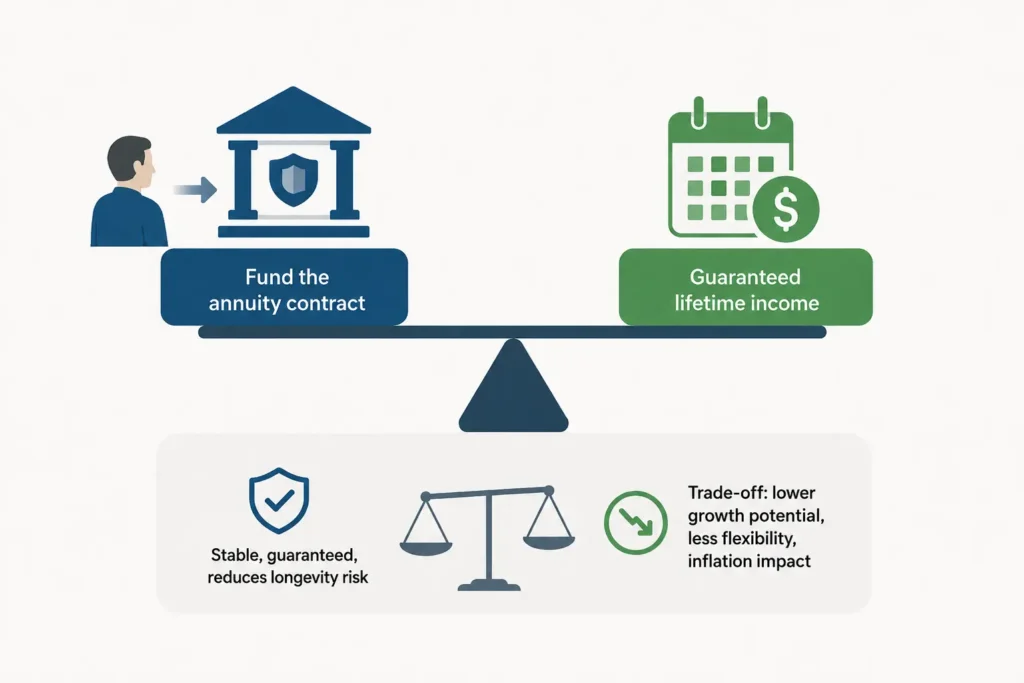
One of the strongest selling points of an annuity is the potential for guaranteed lifetime income.
That can be valuable because longevity risk—the risk of outliving your assets—is real. Someone who retires at age 65 and lives to 95 may need their retirement assets to support 30 years of spending.
An annuity can transfer part of that longevity risk to an insurance company. However, guaranteed income does not mean the insurance company is creating additional money without a tradeoff. Insurers use assumptions about life expectancy, interest rates, withdrawal timing, expenses, and other factors to price these contracts.
Depending on the annuity, income may be created through annuitization, where the contract value is converted into periodic payments, or through an income rider, which provides a contractual method for calculating future withdrawals.
The amount of income may depend on the original premium, the age when income begins, whether payments continue for one life or two, and the other benefits selected.
For example, starting income at age 70 may produce a higher payment than starting at age 60 because the insurer expects to make payments for a shorter period. Choosing income that continues for a surviving spouse may reduce the initial payment compared with a single-life option.
Inflation also matters. If someone receives $3,000 per month starting at age 65 and that payment never increases, they may still receive $3,000 at age 85, but that money may buy considerably less.
Are 401(k)s and IRAs Too Risky Near Retirement?
Another common argument is that the stock market is too volatile for older investors and that money in a 401(k) or IRA should therefore be moved into an annuity.
The problem with that framing is that a 401(k) or IRA is an account type, not an investment.
Think of the account as a container. The level of risk depends largely on what is held inside it.
If a portfolio is concentrated in highly volatile stocks, it can certainly experience significant market swings. But as retirement approaches, the asset allocation can be changed. An investor may reduce exposure to volatile assets and increase allocations to bonds, U.S. Treasuries, cash, money market funds, or other investments with different risk characteristics.
The financial markets offer far more than stocks alone.
So the better question is not, “Is my 401(k) risky?” It is, “How are the assets inside my 401(k) or IRA allocated?”
That distinction matters because retirement planning does not necessarily require choosing between an aggressive stock portfolio and putting everything into an annuity.
“The Market Goes Up, You Gain. The Market Goes Down, You Don’t Lose.”
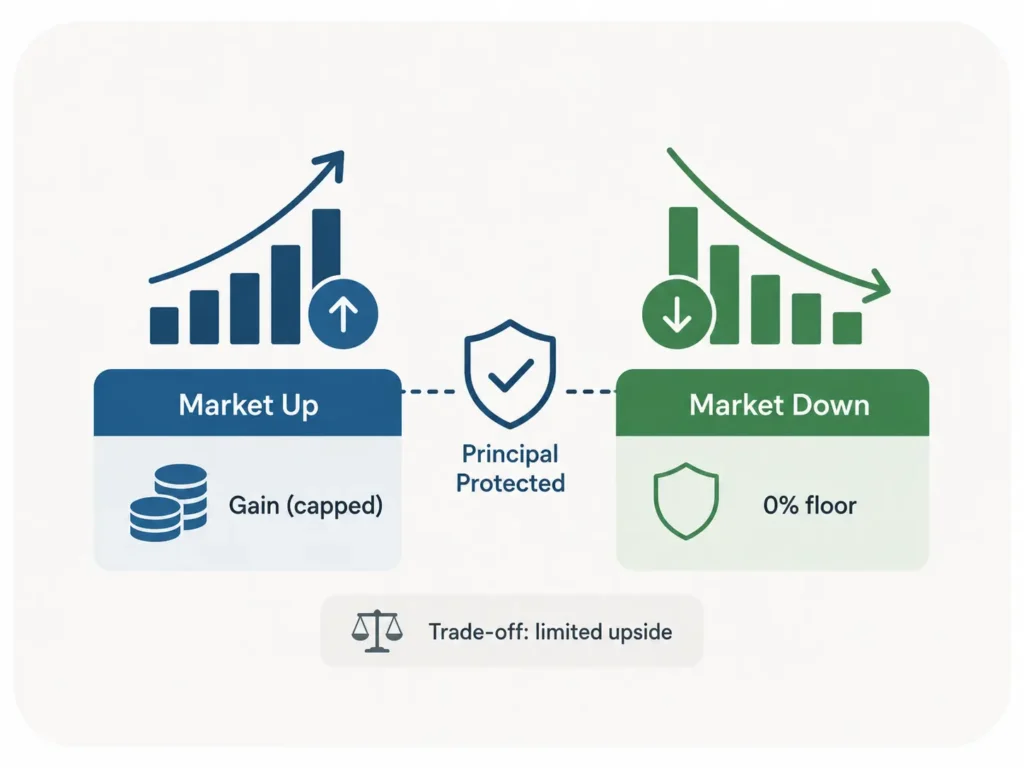
This is one of the most attractive messages associated with fixed indexed annuities.
A fixed indexed annuity does not simply invest your money directly in the S&P 500 and then have the insurance company absorb all market losses. Instead, interest is credited according to a formula linked to an index.
That formula may include a cap, which limits the maximum credited interest; a participation rate, which determines how much of the index gain is used; or a spread, which is deducted before interest is credited.
Consider a simple example.
Suppose you have $100,000 in a fixed indexed annuity with a 5% cap. If the S&P 500 rises 20% in the first year, the contract may credit only 5%, bringing the value to approximately $105,000.
If the index falls 10% the following year and the strategy has a 0% floor, the contract may credit 0% rather than a negative return, leaving the value around $105,000.
That 0% floor is a meaningful benefit. The tradeoff is that the upside may also be limited.
For comparison, an investment that actually gained 20% and then lost 10% would end at approximately $108,000. The annuity in the example would be around $105,000.
This does not prove that direct investing is always better. If a different period were selected—especially one involving a severe market decline—the annuity could look more attractive. The point is simply that downside protection usually comes with limitations somewhere else.
There are also other differences. Investors who directly own stocks or funds may receive dividends, and they generally have more flexibility to buy, sell, change allocations, or access their money.
A 0% floor also does not necessarily mean you can withdraw the full contract value whenever you want without consequences. If money is withdrawn during a surrender period, a surrender charge may apply.
“This Annuity Is Guaranteed to Grow 8% or 10% Per Year”
Another area that can create confusion is the use of large guaranteed percentages.
If someone says an annuity grows at 8% or 10% guaranteed, the first question should be:
8% or 10% on what value?
Some annuities with income riders may show both an account value and an income benefit base.
The account value is the actual contract value.
The income benefit base is a separate value used to calculate future income benefits.
An 8% or 10% figure may refer to a roll-up rate applied to the income benefit base rather than an investment return earned on the actual account value.
For example, someone may deposit $300,000. Later, the statement might show an account value of $330,000 and an income benefit base of $450,000.
The $450,000 may not be money that can be withdrawn.
Instead, it may be used in a formula to determine future income. If the contract allows a 5% withdrawal based on that benefit base, the $450,000 could be used to calculate approximately $22,500 per year of income.
If the contract is surrendered, however, the amount actually received may be based on the account value and other contract provisions.
Whenever a number on a financial contract appears to grow very quickly, it is important to understand what that number represents and what rights the owner actually has to it.
Is a 20% or 30% Bonus Really Free Money?

Bonuses can also be very attractive.
An annuity might be marketed with a 20% or even 30% bonus on the amount deposited. If someone puts in $300,000, a 20% bonus could make it appear that the contract immediately increased to $360,000.
But the important question is where that bonus is being credited.
In some contracts, a bonus may be added to the account value but subject to vesting or holding-period requirements. In others, it may be added primarily to the income benefit base, meaning it increases the value used to calculate future income rather than the amount that can be withdrawn immediately.
So a statement showing $360,000 does not necessarily mean the contract can be surrendered the next day for $360,000.
If the contract is terminated early, part of the bonus may be forfeited, recaptured, or subject to other provisions.
The larger the bonus, the more important it becomes to understand the conditions attached to it.
What Does “No Fee Annuity” Really Mean?
Some annuities are marketed as having no annual management fee.
In some cases, that can be accurate. A fixed annuity or fixed indexed annuity may not charge a traditional annual asset-management fee like some investment accounts do.
But there is an important difference between not seeing a direct annual fee and the product having no economic cost.
Insurance companies still have operating expenses, distribution costs, compensation expenses, and profit requirements. Those economics may be reflected in how the product is structured and how its benefits are priced rather than appearing as a line item showing a 1% annual fee.
This is also why comparing products based only on fees can be misleading.
Suppose one product has no explicit fee while another charges a fee. It might appear obvious that the no-fee product is better. But if the product charging a fee provides significantly more value, flexibility, or useful benefits than the amount of the fee, it may still be economically superior.
Likewise, paying a high fee for little additional value would not make sense.
The better question is not simply, “Does this product charge a fee?” It is, “What am I paying, directly or indirectly, and what am I receiving in return?”
When Can an Annuity Make Sense?
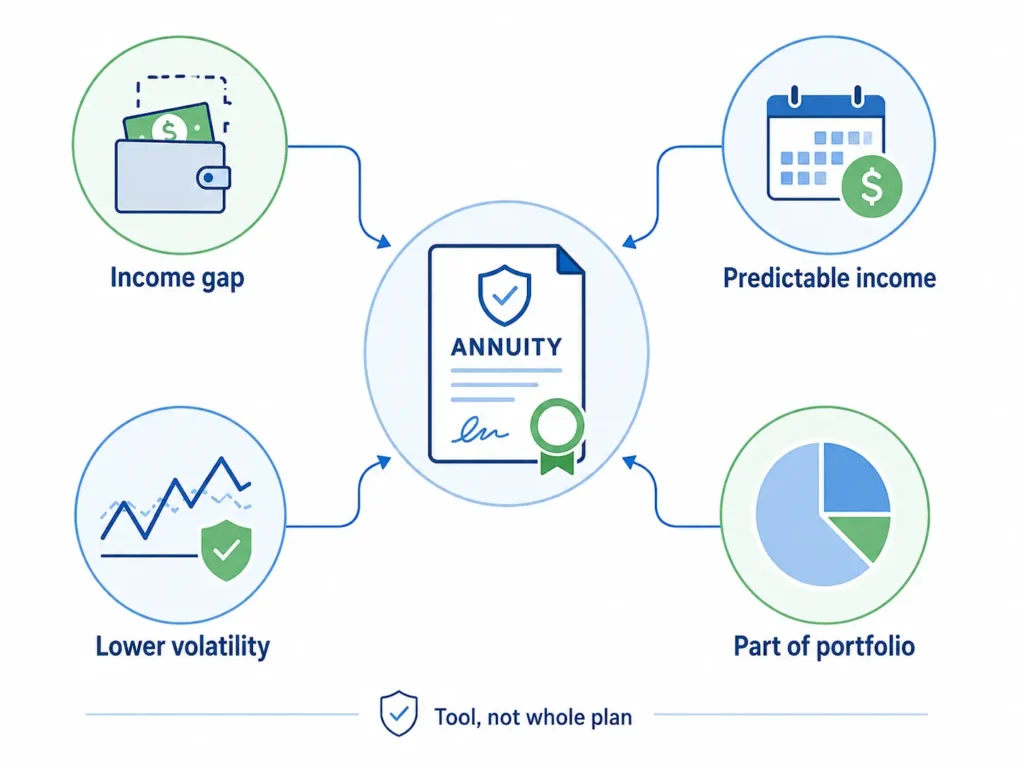
Annuities can be useful when they solve a specific problem within a broader financial plan.
One common example is a retiree whose Social Security and other reliable income sources do not fully cover essential expenses. That person may want to convert part of their assets into a more predictable lifetime income stream.
Another retiree may be highly uncomfortable with market volatility and willing to give up some growth potential or liquidity in exchange for additional guarantees.
The important phrase is part of the portfolio.
Reaching age 60 or 65 does not automatically mean that an entire 401(k) or IRA should be moved into an annuity.
Retirement assets may serve several different purposes. Some money may need to continue growing to help offset inflation. Some may need to remain liquid for emergencies or large expenses. Some may be intended to generate income. Other assets may need to remain flexible for tax planning, Roth conversions, or required minimum distributions.
If an annuity solves one of those problems effectively, it may have a role in the overall strategy.
What Should You Do With a 401(k), IRA, or Savings Before Retirement?
There is no single answer that works for everyone.
Consider two people who are both age 65 and both have $500,000.
The first receives $3,500 per month from Social Security and $2,000 per month from a pension. Their home is paid off, and monthly expenses are about $5,000. Most of their basic spending is already covered by reliable income.
The second person also has $500,000 but has no pension, receives less Social Security, still has a mortgage, and spends $8,000 per month.
They have the same amount of savings, but very different retirement income needs.
That is why retirement planning should begin with the financial situation rather than the product.
How much income is needed each month? How much is already covered by Social Security, pensions, or rental income? How large is the remaining gap? How much money needs to stay liquid? How much growth is needed to keep up with inflation? How much market volatility is acceptable? What are the tax implications? Are Roth conversions worth considering before required minimum distributions begin?
Only after those questions are addressed does it make sense to ask whether some portion of the portfolio should be converted into guaranteed income.
If so, then the next questions become: Which type of annuity? How much should be allocated? What benefits are being purchased? And are the tradeoffs reasonable?
A Better Way to Think About Annuities in Retirement Planning
In financial planning, the more attractive, safe, or simple a product sounds, the more important it is to understand what is happening underneath the surface.
That does not mean the product is bad. It means that nearly every financial benefit comes with some type of tradeoff.
A good retirement decision is not necessarily one that eliminates all risk. That is rarely possible.
The more useful goal is to understand which risks you are willing to keep, which risks you want to transfer, and what you are giving up in exchange.
An annuity can be a valuable tool when it solves the right problem. But it should be evaluated as one part of a broader retirement plan rather than chosen because of a large bonus, an attractive guaranteed percentage, a fear of market losses, or a claim that the product has no fees.