

A 401(k) is one of the most important retirement accounts available to many American workers. But having a 401(k) and actually understanding how it works are two very different things. Someone can contribute to a 401(k) for years without fully understanding how much their employer is adding, how the money is invested, whether Traditional or Roth contributions make more sense, or what they should do with the account after changing jobs or entering retirement.
One of the most common misunderstandings is assuming that a 401(k) itself is a risky investment. It is not. A 401(k) is an account. The level of risk depends largely on the investments held inside the account.
Why Is a 401(k) Important?
Retirement accounts help workers systematically save and invest for the future while often providing meaningful tax advantages.
In the past, defined benefit pension plans were more common. With a pension, an employer generally promises a retirement benefit based on factors such as salary and years of service.
A 401(k) works differently. It is a defined contribution plan, meaning the outcome depends on how much is contributed and how the investments perform. Employees can contribute part of their pay, employers may contribute as well, and the final balance depends on both contributions and investment results.
With a pension, the question is often, “How much will I receive each month in retirement?” With a 401(k), the questions become, “How much have I accumulated?” and “How should I use that money in retirement?”
That difference matters. A 401(k) gives workers more control, but it also places more responsibility on them to save, invest, and eventually withdraw the money appropriately.
Where Does the Money in a 401(k) Come From?
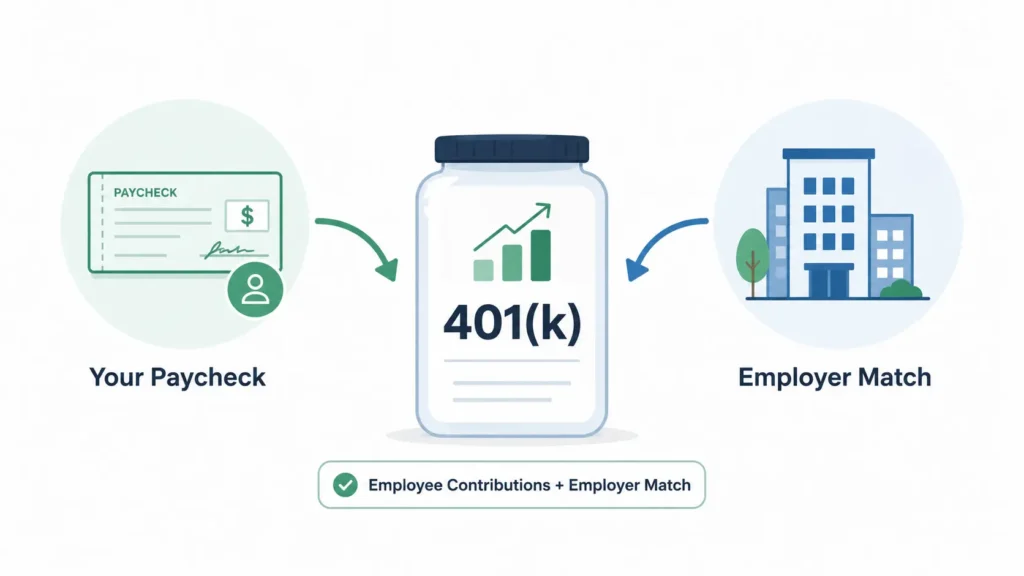
The first source is usually the employee’s own paycheck.
For example, if someone earns $80,000 per year and contributes 10% to a 401(k), about $8,000 will be directed from payroll into the account during the year.
Many employers also offer an employer match. For example, a company might match 100% of the first 3% an employee contributes. If the employee earns $80,000 and contributes $2,400, the employer may add another $2,400.
One common misunderstanding is thinking that if an employer matches up to 5%, the employee can only contribute 5%. That is not correct. The 5% may only determine how much the employer contributes. The employee may still be allowed to contribute more, subject to the plan and annual IRS limits.
For 2026, the employee elective deferral limit for most 401(k) plans is $24,500. Workers age 50 and older may also qualify for catch-up contributions.
The important point is that the employer match and the employee contribution limit are two separate things.
Traditional 401(k) vs. Roth 401(k)
A 401(k) plan may allow Traditional contributions, Roth contributions, or both. The primary difference is when income taxes are paid.
With a Traditional 401(k), employee contributions are generally made before federal income tax is calculated. For example, if someone earns $100,000 and contributes $10,000 to a Traditional 401(k), that $10,000 will generally reduce taxable income for that year. Later, taxable withdrawals are generally included in income.
A Roth 401(k) works in the opposite direction. Contributions are made with after-tax dollars, so there is no current-year federal income tax deduction. However, qualified withdrawals can generally come out free of federal income tax, including both contributions and investment growth.
Neither Traditional nor Roth is automatically better.
If someone is in a relatively high tax bracket today but expects to be in a lower tax bracket in retirement, Traditional contributions may be more attractive in some situations. If someone is in a lower tax bracket today but expects significant taxable income later, building Roth assets may be useful.
In many cases, using both can help create more flexibility in retirement by giving the household access to assets with different tax treatments.
How Much Should You Contribute to a 401(k)?
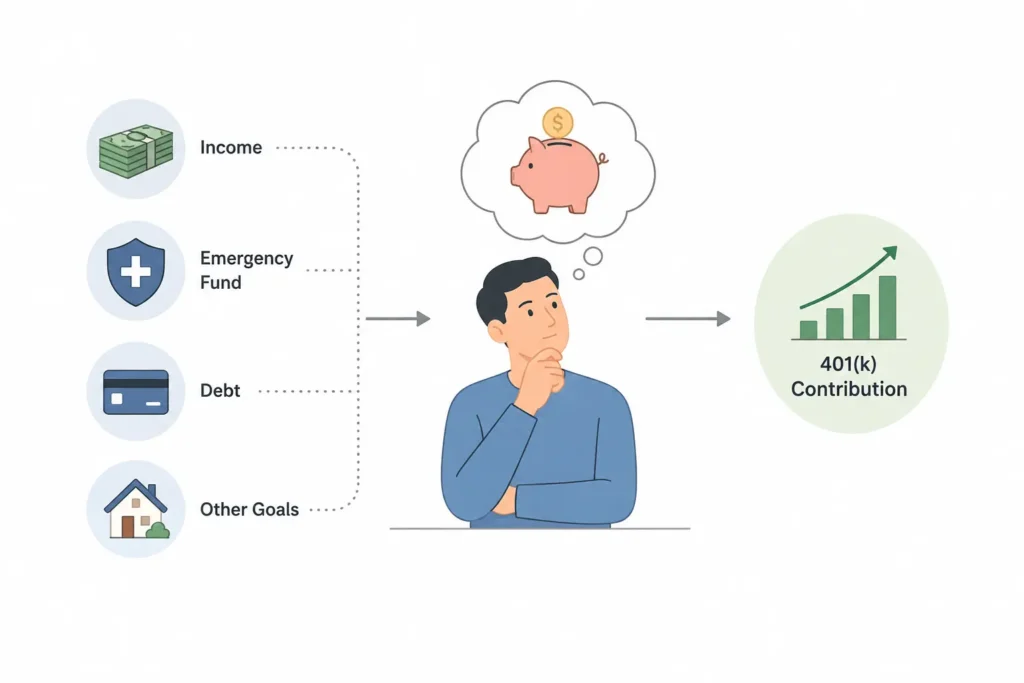
There is no single percentage that works for everyone.
The first step is usually to understand how much is required to receive the full employer match. If an employer matches 5% but the employee contributes only 2%, part of the employer benefit may be left on the table.
After that, the question becomes whether contributing more makes sense.
That decision should be based on the entire financial picture. Does the household already have an emergency fund? Is there high-interest credit card debt? Is money also needed for a home purchase, education expenses, or other major goals?
Age, years until retirement, current savings, expected spending, Social Security, pension income, and other assets can all affect the appropriate contribution level.
A 30-year-old just beginning a career may need a very different strategy than someone who is 60 and only a few years from retirement.
Contributing more to a 401(k) is not automatically the best decision if it causes other parts of the financial plan to become underfunded. Retirement savings, emergency reserves, debt repayment, housing goals, and other priorities need to work together.
A 401(k) Is an Account, Not an Investment
This is one of the most important concepts to understand.
A useful way to think about a 401(k) is as a container. The container determines how money goes in, what tax rules apply, when money can come out, and what regulations govern the account. But the container does not determine what the money is invested in.
Inside the plan, employees may have choices such as an S&P 500 index fund, large-cap stock funds, international stock funds, bond funds, money market funds, or target-date retirement funds.
Two people can each have $500,000 in a 401(k) and still have completely different levels of investment risk. One person may hold 90% stocks, while another may hold 30% stocks and 70% bonds.
That is why it is misleading to say that a 401(k) is inherently “risky” or “safe.” The risk comes largely from the investments and the asset allocation inside the account.
This distinction is especially important when someone is told that they should move money out of a 401(k) simply because the account has market risk and place it into another financial product such as an annuity or indexed universal life insurance. Any financial product should be evaluated based on the person’s needs, goals, costs, risks, liquidity, and overall financial plan rather than on the assumption that the 401(k) itself is the problem.
A 401(k) also should not be evaluated in isolation. If a household also has IRAs, taxable brokerage accounts, real estate, and cash, all of those assets should be considered together.
Vesting and Ownership of 401(k) Money
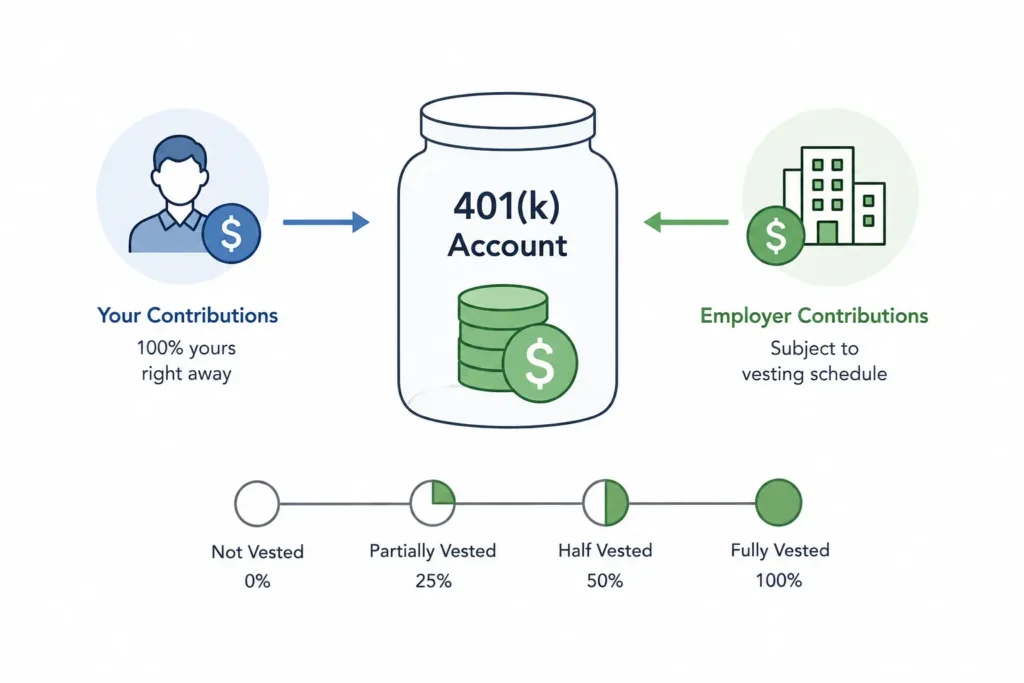
Employee contributions to a 401(k) are generally fully owned by the employee.
Employer contributions may be different because they can be subject to a vesting schedule.
Vesting determines when an employee gains full ownership of employer contributions.
For example, suppose an employee has contributed $20,000 and the company has contributed another $5,000. The account may display a total balance of $25,000, but if the employer contribution is subject to a vesting schedule and the employee has not worked there long enough, the employee may not yet own the entire $5,000.
Some plans provide immediate vesting. Others require the employee to remain with the company for a certain period.
The plan’s Summary Plan Description can help explain the specific vesting rules.
Even when the money belongs to the employee, a 401(k) is still a retirement account. Taking money out too early can result in income taxes and potentially an additional 10% early distribution tax unless an exception applies.
One commonly discussed threshold is age 59½. Another important exception is often called the Rule of 55.
In certain situations, if someone separates from service during or after the calendar year in which they turn 55, distributions from that employer’s plan may avoid the 10% early distribution tax. However, pre-tax distributions may still be subject to ordinary income tax.
The Rule of 55 also does not work the same way with an IRA, which is one reason someone who retires in their mid-50s should understand the rules before automatically rolling a 401(k) into an IRA.
What Happens to a 401(k) When You Leave a Job?
Leaving a job does not mean the 401(k) has to be cashed out.
One option is to leave the money in the former employer’s 401(k), assuming the plan allows it. This may make sense if the plan has good investment choices, low costs, and useful features.
A second option is to roll the money into a new employer’s 401(k), if the new plan accepts rollovers.
A third option is to roll the money into an IRA.
A direct rollover from a pre-tax 401(k) to a Traditional IRA generally does not create taxable income at the time of the rollover.
An IRA may provide more investment flexibility, but that does not mean an IRA is always better than a 401(k). Some 401(k) plans have very low costs, different creditor protections, or useful withdrawal rules such as the Rule of 55. Holding pre-tax IRA money can also affect certain strategies such as the Backdoor Roth.
Another option is to cash out the account. This is the option that deserves the most caution.
If someone has $100,000 in a Traditional 401(k) and withdraws the entire amount, that distribution may be included in taxable income. If the person is under the applicable age and no exception applies, the additional 10% early distribution tax may also apply.
If the goal is simply to move retirement money from one account to another, a direct rollover is generally worth considering before requesting that the distribution be paid directly to the participant.
What Happens to a 401(k) in Retirement?
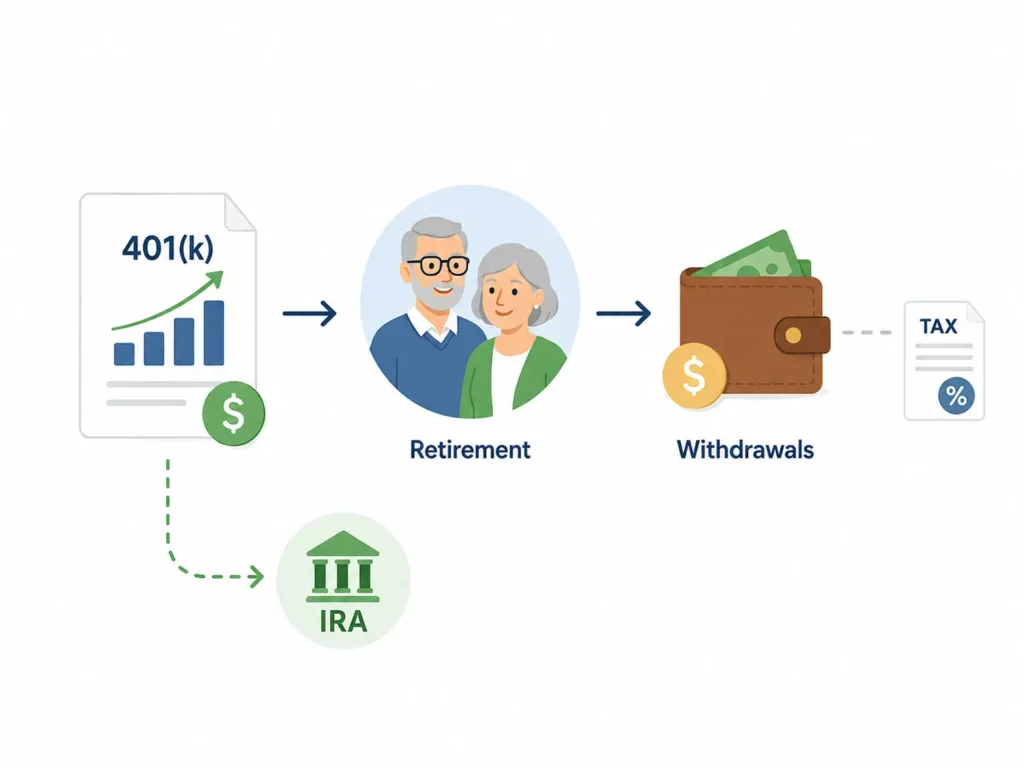
As retirement approaches, the purpose of the 401(k) begins to shift from accumulation to distribution.
During the working years, the main questions are how much to contribute and how to invest. In retirement, the questions become: Which accounts should I withdraw from? When should I take money out? And how much should I withdraw?
Suppose a 65-year-old has $1 million in a Traditional 401(k). That is a significant retirement asset, but much of that money still carries a future tax liability.
Taxable withdrawals are generally included in income. At the same time, a retiree may also have Social Security, pension income, IRA withdrawals, taxable investments, rental income, and other sources of cash flow.
That means retirement planning is not just about how much money someone has. It is also about how different income sources are coordinated.
Some retirees may choose to roll an old 401(k) into a Traditional IRA for greater flexibility in investment management and withdrawals. Others may have good reasons to keep the money in the 401(k).
There is no single answer that works for everyone.
Roth Conversions and RMDs
A Roth conversion involves moving pre-tax retirement money into a Roth account and paying income tax on the converted amount.
For example, someone may retire at 65 but delay Social Security until 70. If Required Minimum Distributions have not yet started, taxable income during those years may be lower than it was during employment. That period can sometimes create an opportunity for tax planning.
But more Roth conversion is not automatically better.
Converting too much in one year can increase taxable income, push the taxpayer into a higher marginal tax bracket, and affect other parts of the retirement plan, including taxation of Social Security benefits or Medicare premiums through IRMAA.
Required Minimum Distributions, or RMDs, are another major consideration.
Under current law, the starting age for RMDs may be 73 or 75 depending on the individual’s birth year. If Traditional 401(k) and Traditional IRA balances become very large, future RMDs can create substantial taxable income even when the retiree does not need all of the money for spending.
Roth 401(k) accounts are no longer subject to lifetime RMDs for the original account owner.
This is why retirement planning is not simply about investing until retirement and then withdrawing money as needed. Withdrawals, rollovers, Roth conversions, Social Security, Medicare, and taxes may all need to be coordinated.
Can Self-Employed Individuals and 1099 Workers Have a 401(k)?
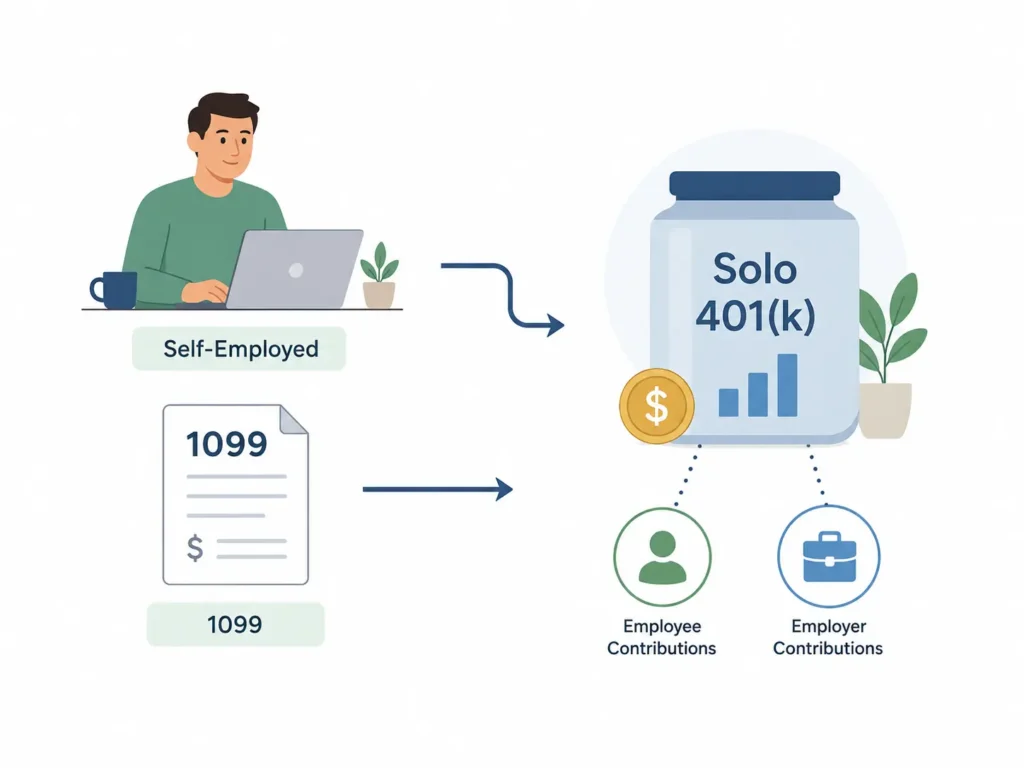
Yes. A 401(k) is not limited to employees of large companies.
A self-employed individual with no eligible employees other than a spouse may be able to establish a Solo 401(k), also known as a One-Participant 401(k).
A Solo 401(k) allows the business owner to contribute in two capacities: as the employee and as the employer.
For 2026, an eligible participant may contribute up to $24,500 as the employee, subject to the applicable rules. The business may then make an additional employer contribution.
The overall contribution limit for 2026 can reach $72,000 before catch-up contributions, depending on compensation, business structure, and other applicable limits.
That does not mean every self-employed person can automatically contribute $72,000. The allowable amount depends on business income, entity structure, and participation in other retirement plans.
Self-employed individuals may also have alternatives such as a SEP IRA or SIMPLE IRA.
The broader point is that being self-employed does not mean giving up access to tax-advantaged retirement planning. In some cases, business owners actually have several choices, but they also have more responsibility for selecting and establishing the right plan.
A 401(k) Should Be Part of the Overall Financial Plan
How much money is accumulated is only one part of retirement planning. How that money is invested, moved, taxed, and eventually used is another.
Someone can spend 20 or 30 years building a large 401(k) balance, but without a clear strategy for investments, rollovers, withdrawals, taxes, and coordination with other income sources, important planning opportunities can still be missed.
The ultimate goal of a 401(k) is not simply to create the largest possible account balance. The goal is to build a retirement resource that can support the person’s financial life over time.
A simple place to start is by reviewing four things: how much is currently being contributed, how much the employer matches, whether contributions are Traditional or Roth, and what the money inside the account is actually invested in.
Understanding those four areas can make it much easier to evaluate the 401(k) as part of the household’s broader investment, tax, and retirement strategy.