

1099 and W-2 are two common terms used to describe how workers are paid in the United States. But the difference between 1099 and W-2 is not just about which tax form someone receives at the end of the year or how much they are paid per hour. Each structure comes with different tax responsibilities, benefits, insurance considerations, retirement planning opportunities, business responsibilities, and financial risks.
One common misunderstanding is thinking that 1099 or W-2 status is something a business owner or worker can simply choose based on preference. Some people think 1099 is better because the pay may look higher. Others think W-2 is better because it can provide more stability and workplace benefits. But the better question is not “which one looks better?” The better question is: what is the nature of the work, what is the real relationship between the business and the worker, and which structure properly fits that relationship?
Why tension often exists between business owners and workers
A business usually involves three important groups: customers, workers, and business owners. Customers pay for the product or service. Workers help create, operate, or deliver that product or service. Business owners organize the system, invest capital, take financial risk, manage expenses, and try to keep the business operating over the long term.
These three groups depend on each other. Without customers, there is no revenue. Without workers, the business may struggle to serve customers well. Without business owners or leadership, there may be no workplace, no process, no capital investment, and no long-term direction.
Tension often appears because each group needs something different from the same business system. Customers want fair prices, quality, and good service. Workers want fair pay, good benefits, stability, respect, and reasonable working conditions. Business owners need profit, cost control, risk management, operational efficiency, and the ability to reinvest.
The challenge is that there is no fixed definition of “fair” in every situation. What a worker considers fair compensation may feel like a significant cost to the business owner. What a business owner considers necessary for the company to survive may feel insufficient to the worker. That is why business tension is not only about wages or profit. It is about balancing value, cost, risk, responsibility, and fairness from each side’s perspective.
The solution is not one side winning and the other side losing
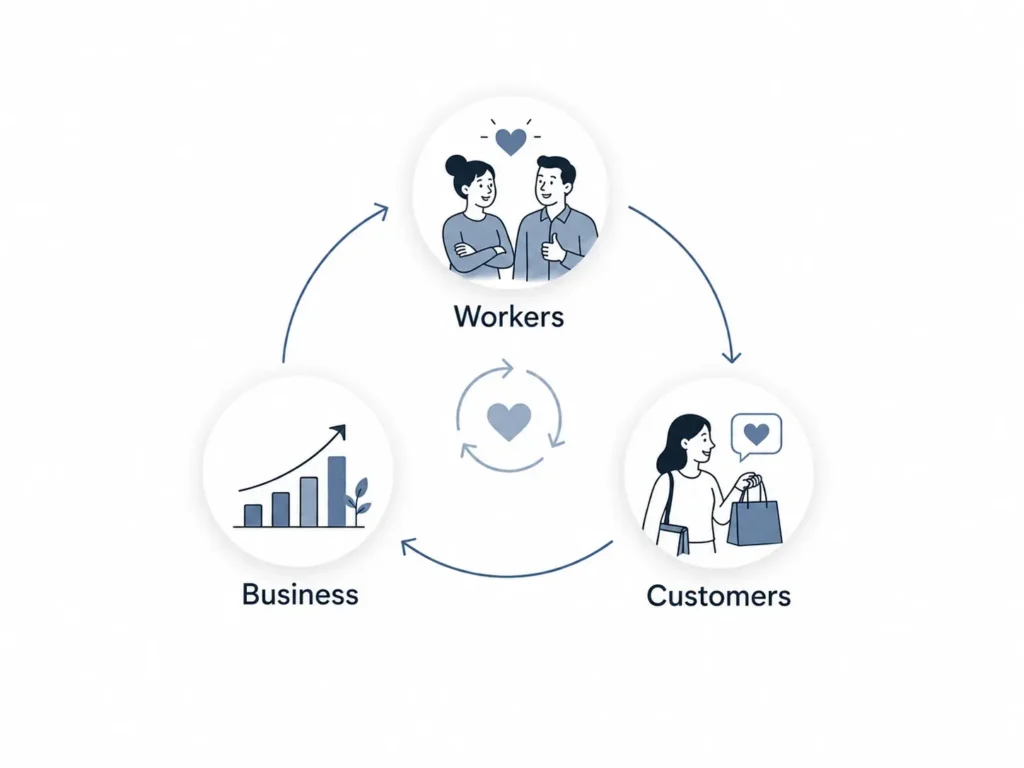
If business is viewed only as a zero-sum game, where one side must lose for another side to win, the model often becomes unhealthy over time. A stronger way to view business is as a continuous value cycle.
When a business treats workers well, workers are more likely to stay, perform well, and serve customers better. When customers receive better service and better value, they are more likely to return and continue supporting the business. When the business grows in a healthy way, owners may be able to generate stronger long-term profits and reinvest back into the company.
This is why wages alone do not tell the full story of a job. A job may also include health insurance, retirement benefits, paid time off, income protection, career development, bonuses, and sometimes incentives tied to business performance.
For business owners, labor cost also does not tell the full story. Retaining good employees, training, company culture, service quality, compliance, reputation, and long-term profitability all matter. The best structure depends on the nature of the business, the type of work, the company’s financial situation, and the needs of the worker.
Can a business or worker simply choose W-2 or 1099?
W-2 or 1099 status is not simply a personal choice. A business owner cannot simply choose 1099 because it may reduce costs or administrative work. A worker also cannot simply choose 1099 or W-2 because one appears more attractive personally.
The better question is: what is the nature of the work, and what is the real relationship between the business and the worker?
If the business controls how the work is done, when the work is done, what tools are used, how the worker is trained, and how the worker participates in the regular operation of the company, the relationship may look more like an employee relationship. If the worker operates independently, controls how the work is performed, uses their own tools, serves multiple clients, takes business risk, and provides a specific service or result, the relationship may look more like an independent contractor relationship.
Misclassification can create tax, legal, payroll, benefits, and compliance risks for both the business and the worker. Classification should be understood first. After the correct structure is identified, both sides can then think about how to use the benefits and opportunities that come with that structure.
What is W-2 status, and how can businesses use it?
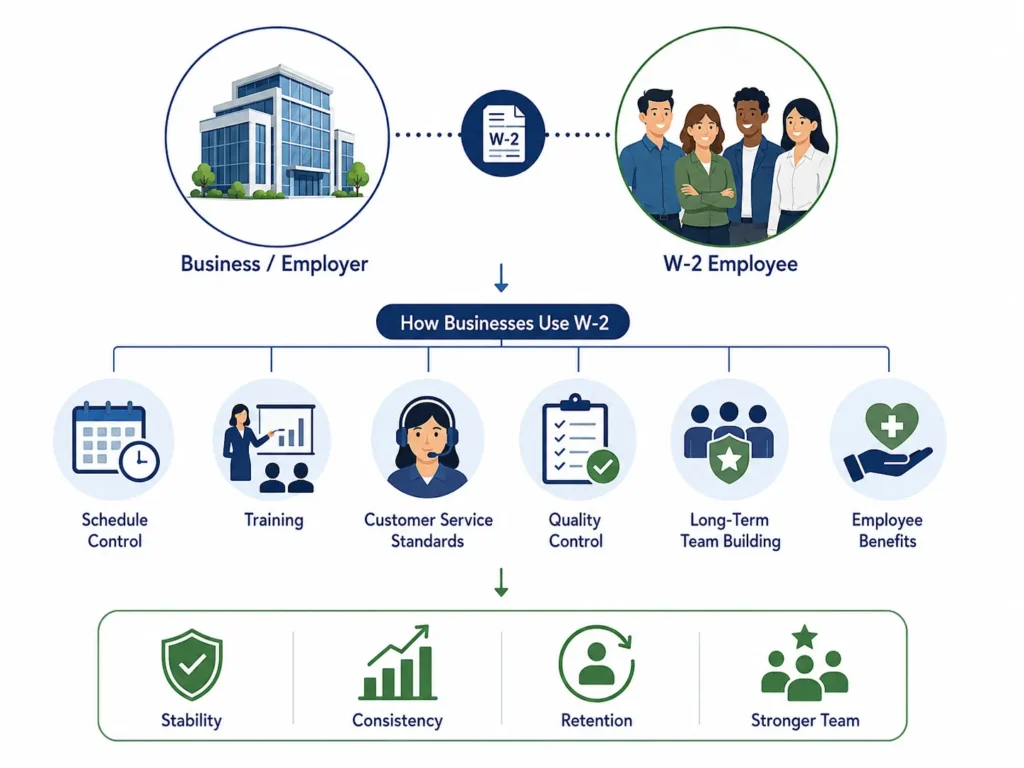
W-2 status is generally connected to an employee relationship. In broad terms, if a business has the right to direct and control what the worker does, how the work is done, when the work is done, which processes are used, and how the worker serves customers, the relationship may look more like W-2 employment.
For businesses, W-2 can be useful when the company needs consistency, training, schedule control, customer service standards, quality control, and a long-term team. W-2 employment helps a business build company culture, train people according to internal standards, create a consistent customer experience, and develop employees over time.
From a financial planning perspective, one major advantage of W-2 employment is that the business can design benefits as part of the total compensation package instead of only paying wages. These benefits may include health insurance, retirement plans, employer matching contributions, paid time off, bonuses, disability insurance, and other employee benefits depending on the company.
When designed properly, a benefits package can help a business compete for talent, retain good employees, create stability for workers, and help employees see a long-term future with the company. Sometimes a business can create value for workers not only by increasing direct wages, but also by offering a stronger benefits system.
However, W-2 also comes with additional responsibilities for the business, including payroll systems, tax withholding, payroll taxes, workers’ compensation, unemployment insurance, benefits administration, recordkeeping, and compliance requirements. For that reason, W-2 should not be viewed only as a cost. When structured properly, it can be an investment in stability, service quality, employee retention, and long-term business growth.
How can employees use W-2 benefits more effectively?
For W-2 employees, one of the biggest mistakes is looking only at salary or hourly pay while ignoring the benefits attached to the job. The total value of a job is not only the amount deposited into a paycheck. It also includes the benefits behind that paycheck.
A W-2 job may include health insurance, dental and vision coverage, paid time off, paid sick leave, disability insurance, life insurance, a retirement plan such as a 401(k), an employer match, an employee stock purchase plan, bonuses, or other workplace benefits depending on the company.
From a financial planning perspective, W-2 employees should understand their paycheck, tax withholding, insurance options, retirement plan, employer match, HSA or FSA options if available, and other benefits that can help protect their family and build wealth.
W-2 income is also often easier to document when applying for a loan, buying a car, renting a home, or applying for a mortgage. W-2 workers often have pay stubs, W-2 forms, payroll history, and employer verification that can make income verification clearer. This does not mean W-2 income automatically guarantees loan or mortgage approval, but it may make the income documentation process more straightforward.
When employees understand and use W-2 benefits properly, they are not only earning wages. They may also be building a stronger financial foundation for both the present and the future.
What is 1099 status, and how can businesses use it?
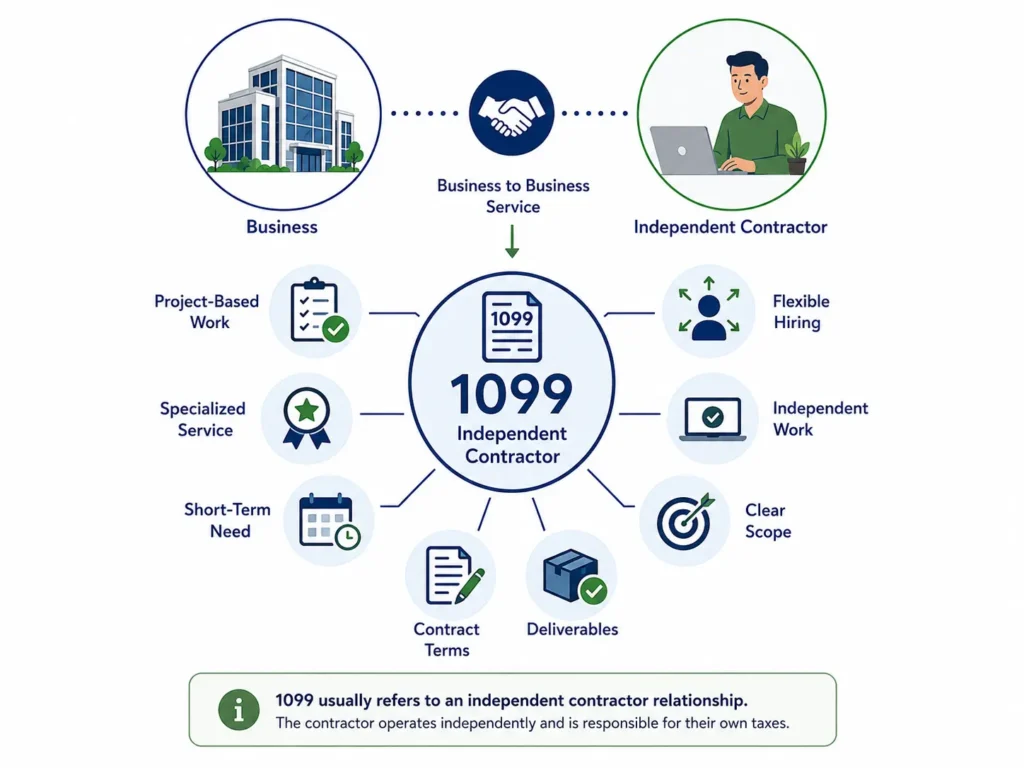
1099 status is generally connected to an independent contractor relationship. A 1099 worker usually does not operate like an employee inside the company’s day-to-day system. Instead, the worker is often more like an individual or small business providing services to another business.
This structure may fit when a business hires someone for a specific project, specialized service, short-term need, or result-based engagement. For example, a company may hire an independent contractor for website design, bookkeeping, consulting, marketing, repairs, photography, construction, or other specialized services.
For business owners, 1099 can create flexibility, especially when the company does not need a full-time employee or does not need to control every step of the work. However, 1099 should not be used simply as a way to avoid payroll taxes, employee benefits, or employer responsibilities if the worker is truly functioning like an employee.
Misclassification can create tax, legal, payroll, recordkeeping, and compliance risks. For that reason, 1099 is most useful when it is structured properly, documented clearly, and aligned with the true nature of the working relationship.
How can 1099 workers use this structure effectively?
For 1099 workers, it is important to understand that 1099 is not just a different tax form at the end of the year. A 1099 worker is often operating more like a small business. That can create opportunities, but it also creates more responsibility.
The opportunity is that 1099 workers may have more control over their time, pricing, clients, services, expenses, and direction. When managed well, 1099 work can allow someone to build a personal brand, serve more clients, increase the value of their services, and avoid being limited completely by a fixed salary.
1099 workers may be able to deduct certain legitimate business expenses depending on their situation. They may also have retirement planning options for self-employed individuals, such as a SEP IRA, SIMPLE IRA, or Solo 401(k), depending on eligibility and business structure.
But to use the 1099 structure well, it has to be managed properly. That means tracking income and expenses, keeping receipts and records, understanding estimated taxes, setting aside money for taxes, managing insurance, building an emergency fund, pricing services high enough, and planning for retirement independently.
A 1099 worker who only looks at the higher hourly rate but does not prepare for taxes, insurance, unpaid time off, retirement planning, and inconsistent income may end up financially behind. But when managed properly, 1099 work can become a path toward building a real business and long-term wealth.
Is W-2 or 1099 better?
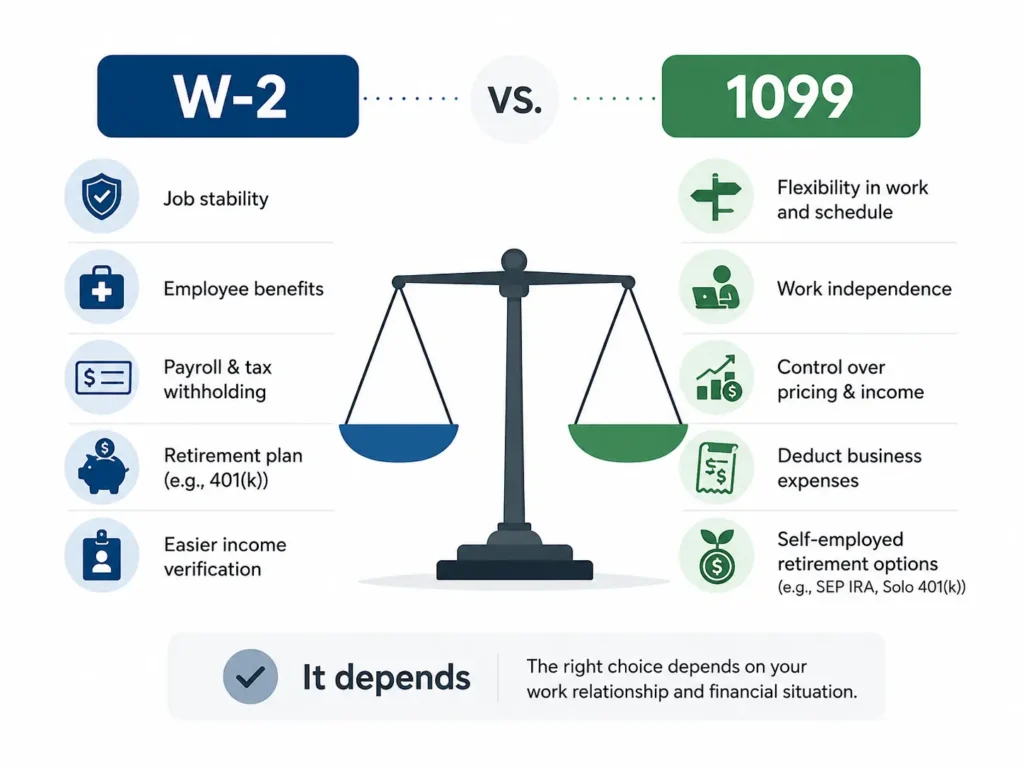
Neither W-2 nor 1099 is automatically better. If one structure were always better than the other, everyone would choose the same one. In reality, each structure is designed for a different type of working relationship, and each comes with different advantages, disadvantages, responsibilities, and opportunities.
W-2 may fit better for someone who values stability, workplace benefits, and simpler tax management. 1099 may fit better for someone who is truly independent, wants flexibility, understands business risk, and can manage taxes, insurance, retirement planning, and investing on their own.
The best structure is the one that matches the true nature of the work. The best financial outcome usually comes from understanding that structure and using the available benefits properly.
This can be compared to sports. To score a valid goal, a player has to understand the rules of the game. The financial system works in a similar way. Building wealth is not about ignoring the rules. It is about understanding the rules and using the opportunities available within them.
Conclusion
Whether someone is a business owner, W-2 employee, or 1099 worker, the goal should not only be asking, “How do I pay less?” or “How do I receive more on paper?” A better question is: what is the correct structure for this work, what responsibilities come with it, and how can that structure be used to build a stronger financial future?
W-2 and 1099 can both be useful when used properly. For W-2 employees, the opportunity may come from understanding employee benefits, retirement plans, insurance options, tax withholding, and long-term career stability. For 1099 workers, the opportunity may come from managing the work like a small business, tracking expenses, planning for taxes, building a retirement strategy, protecting income, and creating long-term wealth with more independence.
For business owners, the opportunity is to build the right structure, attract the right people, reduce unnecessary risk, and create a system where customers, workers, and owners can all benefit over time.
The key is to understand the difference, respect proper classification, and make smart decisions around taxes, benefits, insurance, retirement, and investment planning.
Disclaimer: This content is for general financial education only and should not be considered tax, legal, accounting, payroll, employment law, or personalized investment advice. Worker classification depends on the nature of the work and the specific facts and circumstances. Business owners and workers should consult a qualified tax professional, payroll professional, legal professional, or financial advisor before making decisions.