

U.S. income tax affects how much money a person ultimately keeps after working, investing, running a business, and preparing for retirement. Yet many people only think about taxes during filing season, when they gather their documents, send them to a tax preparer, and wait to see whether they will receive a refund or owe more.
Many of the decisions that affect taxes actually happen long before a tax return is filed. How income is earned, where money is invested, when assets are sold, how retirement accounts are funded, and which accounts are used during retirement can all affect the tax outcome.
Understanding the basics of the tax system does not mean becoming a tax expert. The goal is simply to understand how income tax works and how financial decisions can influence the amount of tax a person may ultimately pay.
Why Do We Pay Income Tax?
Taxes are part of the financial system individuals and businesses operate within. Governments collect different types of taxes to help fund infrastructure, the legal system, schools, national defense, and other public programs.
Federal income tax is one of the major sources of revenue for the federal government.
No one wants to pay more tax than necessary. But from a personal finance perspective, the goal is not to avoid tax obligations. The goal is to understand the rules so that when several legal options are available, a person can make a more informed financial decision.
Does Having a Tax Preparer Mean You Do Not Have to Worry About Taxes?

A common misunderstanding is that once someone has a tax preparer, they no longer need to think about taxes themselves.
In reality, tax preparers can have very different levels of education, professional credentials, experience, and scope of practice. Credentialed professionals such as CPAs, Enrolled Agents, and attorneys may have broader representation rights before the IRS in matters such as audits, collections, and appeals.
A tax preparer may primarily focus on what already happened during the year: reviewing W-2s, 1099s, business income, deductions, and other documents needed to prepare the return.
That does not automatically mean the preparer is also doing year-round tax planning.
Regardless of who prepares the return, the taxpayer is ultimately responsible for the information reported. At a minimum, taxpayers should understand what income is being reported, where major deductions or tax credits are coming from, and why they are receiving a refund or owe additional tax.
Not All Income Is Taxed the Same Way
One of the most important concepts in understanding U.S. taxes is that not all income is treated the same.
Wages may be considered earned income. Profit from a business may be business income. Interest from a bank account is interest income. Dividends from investments are dividend income. Profit from selling an investment may be a capital gain.
For example, if an investment is purchased for $100,000 and later sold for $120,000, the $20,000 profit may be treated as a capital gain. The tax treatment can also differ depending on how long the asset was held.
Retirement income can be treated differently as well. Withdrawals from a Traditional IRA or Traditional 401(k) may generally be included in taxable income, while a qualified Roth IRA distribution may receive different tax treatment.
Even the same investment can create different tax results depending on the type of account holding it. A gain realized in a taxable brokerage account may create capital gains tax, while buying and selling inside a tax-deferred account such as a Traditional IRA or 401(k) generally does not create an immediate capital gains tax at the time of the trade.
This is why coordinating earned income, business income, investment income, and retirement income can become an important part of long-term financial planning.
What Is Being Taken Out of a Paycheck?
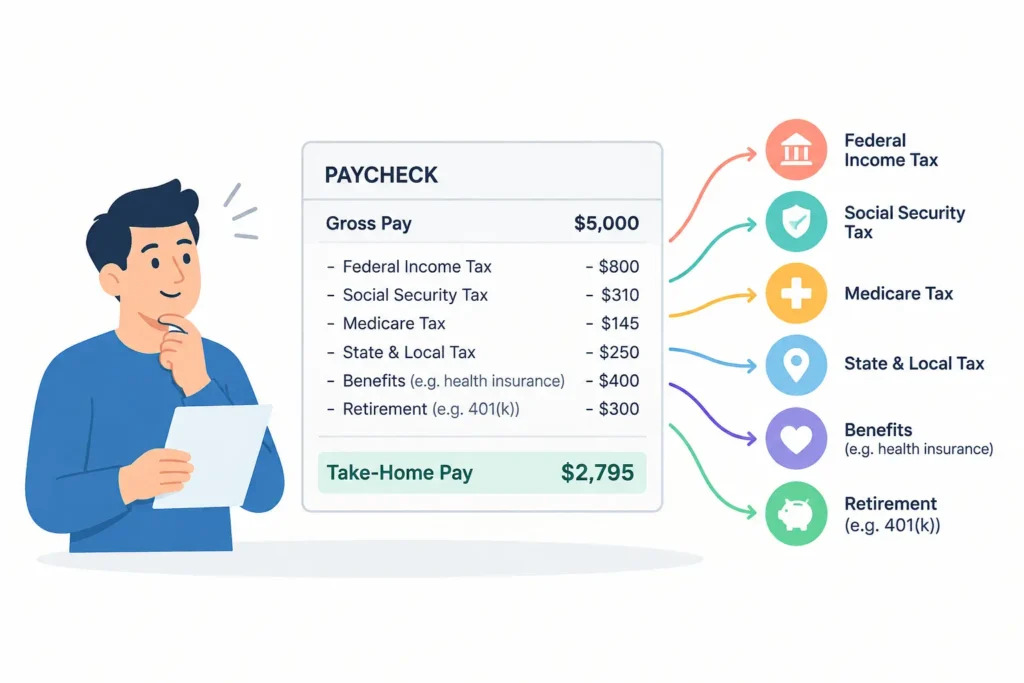
Many employees look at the difference between gross pay and take-home pay and refer to the entire difference as “tax.” In reality, several different items may be deducted.
Federal income tax may be withheld and sent to the IRS throughout the year.
Social Security tax helps fund Social Security benefits such as retirement, disability, and survivor benefits.
Medicare tax helps fund the Medicare program.
Depending on where a person lives, state income tax or local tax may also apply.
A paycheck may also include deductions that are not taxes at all, such as health insurance premiums, 401(k) contributions, HSA contributions, dental insurance, vision insurance, and other employee benefits.
Another important point is that federal income tax withholding is not necessarily the final amount of tax owed.
If a taxpayer ultimately owes $10,000 but had $12,000 withheld during the year, the taxpayer may receive roughly a $2,000 refund.
If only $8,000 was withheld, the taxpayer may owe roughly $2,000 more.
A tax refund is therefore not necessarily “free money” from the IRS. In many cases, it simply means more tax was prepaid than was ultimately owed.
How Is Income Tax Calculated?
A common misunderstanding is that the IRS simply looks at someone’s income, applies one tax rate, and multiplies the two together.
The process is more complicated than that.
A simple way to think about it is as a funnel. A taxpayer begins with different sources of income. Adjustments, deductions, and other tax rules may then reduce the amount that becomes taxable income.
Once taxable income is determined, the tax system applies the appropriate tax brackets. Tax credits may then reduce the amount of tax owed.
Finally, the amount of tax owed is compared with taxes already paid through withholding or estimated tax payments.
In simplified form:
Income → Taxable Income → Tax Calculation → Tax Credits → Compare With Taxes Already Paid
This is why simply knowing that someone earns $100,000 is not enough to determine exactly how much tax that person will owe.
How Do Tax Brackets Actually Work?
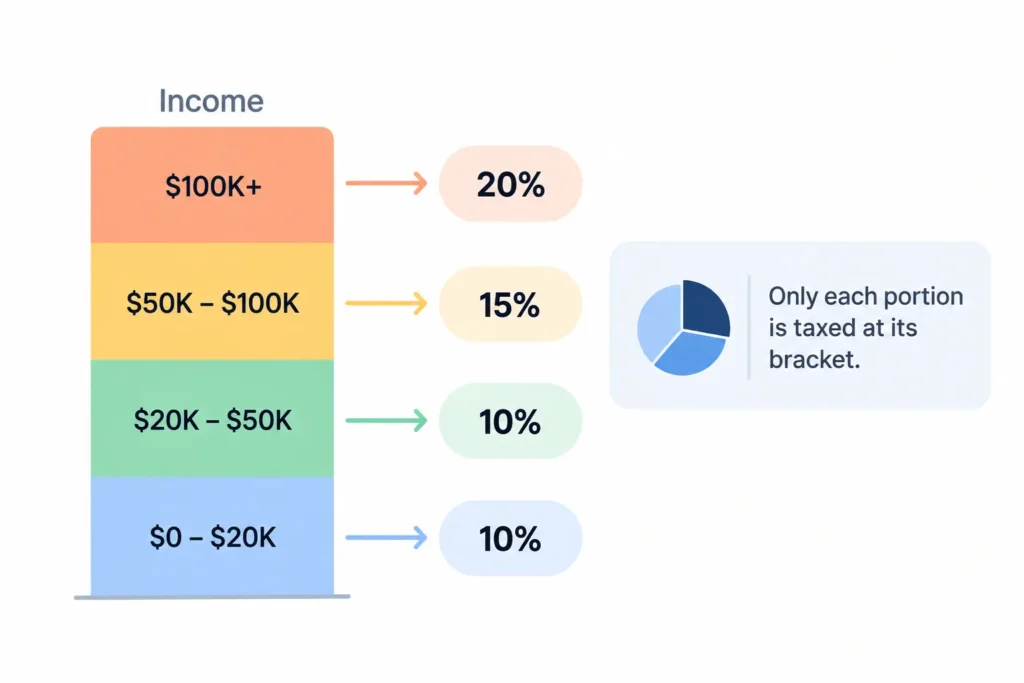
One of the most common misunderstandings is that if someone is in the 24% tax bracket, then all of that person’s income is taxed at 24%.
That is not how the federal income tax system works.
Federal income tax uses progressive tax brackets, meaning different portions of taxable income can be taxed at different rates.
Consider a simplified example that is only meant to illustrate the math and does not represent actual IRS tax brackets:
- The first $10,000 is taxed at 10%
- The next $30,000 is taxed at 15%
- Income above $40,000 is taxed at 20%
If taxable income is $50,000:
The first $10,000 creates $1,000 of tax.
The next $30,000 creates $4,500 of tax.
Only the final $10,000 is taxed at 20%, creating $2,000 of tax.
The total tax is $7,500.
Moving into a higher tax bracket does not mean that all previously earned income suddenly becomes subject to the higher rate.
This is why turning down overtime, a raise, or a promotion simply because of fear of “moving into a higher tax bracket” may be based on a misunderstanding of how the system works.
Why Can Two People With the Same Income Pay Different Taxes?
Two people can both earn $100,000 and still have very different tax outcomes.
One person may be single while another is married filing jointly.
One household may have children and qualify for certain tax credits while another does not.
One person may receive all income from a W-2 job, while another may also have business income.
One person may contribute to pre-tax retirement accounts while another does not.
One person may have capital gains, while another has investment losses.
One person may live in Texas, where there is no individual state income tax, while another lives in a state that imposes income tax.
Even two people with the same final tax liability may have different filing outcomes. One may receive a refund while the other owes additional tax simply because they prepaid different amounts during the year.
This is also why copying another person’s financial decisions can be risky. A strategy that makes sense for one household may not make sense for another.
Common Ways Taxes May Be Reduced or Deferred
There is no single tax strategy that works for everyone. However, several basic concepts appear frequently in tax planning.
Tax Deduction
A tax deduction can reduce taxable income.
This does not mean the IRS reimburses the full amount of a deductible expense. If a business owner spends $10,000 on an expense that qualifies for a deduction, the owner still spent $10,000. The tax benefit comes from reducing taxable income.
Tax Credit
A tax credit can reduce the actual amount of tax owed, depending on the rules of the specific credit.
For that reason, a $1 tax credit and a $1 tax deduction do not have the same value.
Tax Exclusion
A tax exclusion allows certain qualifying income or benefits to be excluded from taxable income.
Tax Deferral
Tax deferral means postponing tax until a later time rather than eliminating it.
A Traditional 401(k) is a familiar example. A person may receive a tax benefit today, but future withdrawals may be taxable.
That is why a tax strategy should not be judged only by how much tax it saves this year. A decision should also be evaluated based on how it may affect finances 10, 20, or 30 years from now.
Tax Preparation vs. Tax Planning
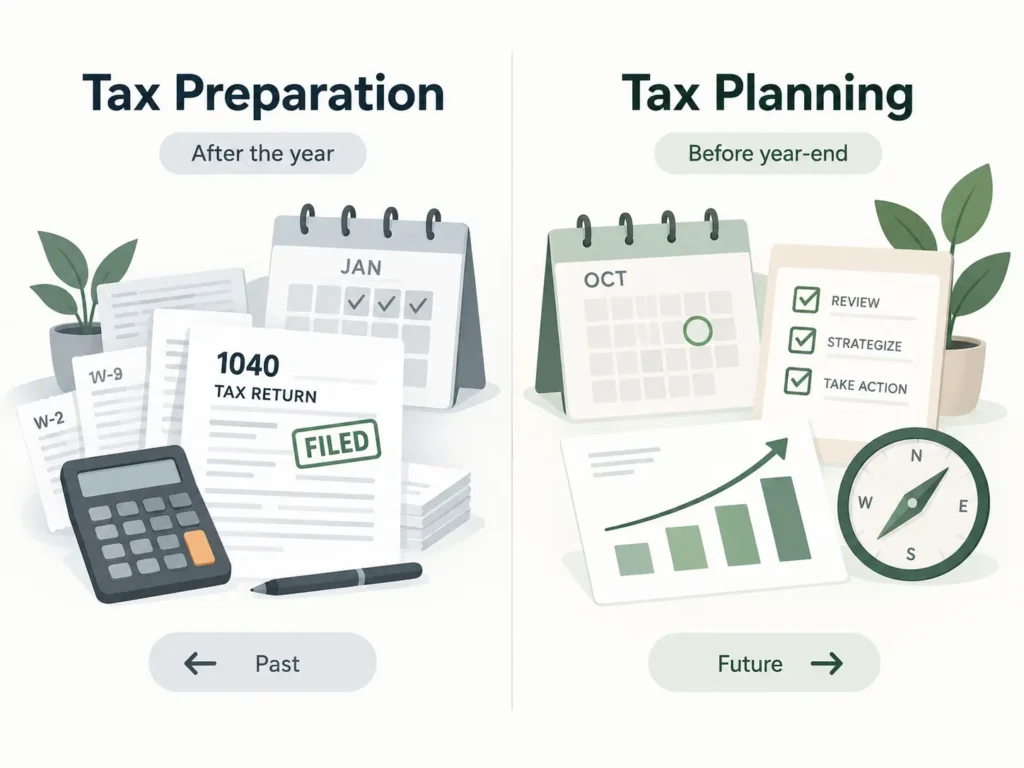
Tax preparation and tax planning are related, but they serve different purposes.
Tax preparation mainly looks backward.
It asks what happened during the previous year: how much income was earned, how much tax was withheld, what deductions or credits may apply, and what needs to be reported on the tax return.
Tax planning mainly looks forward.
Examples may include:
- Expecting unusually high income this year
- Planning to sell an investment with a large gain
- Preparing for retirement
- Considering a Roth conversion
- Deciding which account to withdraw from during retirement
These decisions may affect taxes before the year ends. If someone waits until tax filing season, some planning opportunities may already be gone.
A useful analogy is that tax preparation is like looking at the scoreboard after the game is over. Tax planning is like making strategic decisions while the game is still being played.
Tax planning also does not always mean minimizing this year’s tax bill.
There may be situations where paying some tax today at a lower rate is more reasonable than creating a larger tax obligation later. There may be situations where realizing a capital gain is still the right decision because an investment portfolio needs to be diversified. A Roth conversion may increase taxes today while still supporting a longer-term retirement strategy.
The goal is to coordinate taxes with investments, retirement, cash flow, estate planning, and other financial goals.
A Long-Term View of Taxes and Wealth Building
Taxes should not be viewed only as a bill that appears at the end of the year.
Many tax outcomes are shaped by decisions made much earlier: how income is earned, what types of accounts are used, when investments are sold, how retirement accounts are funded, and which assets are used during retirement.
A single decision may not create a large difference in one year. Over 10, 20, or 30 years, however, the effect can become much more significant.
Instead of asking only:
“How much tax do I owe this year?”
A more useful question may be:
“How will the financial decisions I make today affect my taxes and the amount of money I ultimately keep in the future?”
Building wealth is not only about how much money is earned or how much an investment grows. The amount retained after taxes and how tax obligations are managed over time can also play an important role in long-term financial planning.