

Estate planning is often understood as preparing a will or trust to transfer assets after death. That is an important part of the process, but it is not the full purpose of an estate plan.
A person may experience illness, an accident, or a period when they can no longer manage their own affairs. During that time, they may still be alive but unable to handle finances, communicate with doctors, or make important decisions independently.
Estate planning therefore involves more than deciding who will receive your assets after you die. A more complete plan also considers who can manage your finances if you cannot, who can make medical decisions for you, whether that person understands your wishes, and how your property should be managed after your death.
These issues commonly involve documents such as a Financial Power of Attorney, Health Care Power of Attorney, Advance Health Care Directive, HIPAA Authorization, Last Will and Testament, and Revocable Living Trust.
Do Younger People or People With Limited Assets Need Estate Planning?
A common misconception is that estate planning is only for older people or those with substantial wealth. Someone who is young, does not own a home, has not accumulated significant savings, or is unmarried may assume there is nothing to plan for yet.
However, the need for estate planning is not based only on the value of your assets. Even a young person may be involved in an accident, develop a serious illness, require hospitalization, or temporarily lose the ability to make decisions.
During that period, rent or mortgage payments still become due, bills still need to be paid, insurance coverage must be maintained, and bank accounts, investments, rental properties, or a business may still require attention.
According to the World Health Organization, noncommunicable diseases such as heart disease, stroke, cancer, diabetes, and chronic lung disease account for approximately 74% of deaths worldwide. This illustrates that illness and declining health are real issues many families may eventually face.
Source: World Health Organization — Noncommunicable Diseases
https://www.who.int/health-topics/noncommunicable-diseases
The important question is therefore not only who will receive your assets after death. It is also: If I am still alive but can no longer manage my affairs, who can legally step in to help me?
Can Family Members Automatically Manage Your Finances?

Many people assume that a spouse, child, or other relative can automatically step in and handle everything if they experience a health problem. However, being a family member does not automatically provide legal authority to access or manage someone else’s financial accounts.
For example, an adult child generally cannot simply walk into a bank and withdraw money from a parent’s individual account because the parent is hospitalized. Banks and investment firms must verify that the person requesting access has the legal authority to act on behalf of the account owner.
A relative may sincerely want to help and may know exactly what needs to be done. However, wanting to help and having the legal authority to help are two different things.
This is one reason a Financial Power of Attorney can play an important role in estate planning.
What Does a Financial Power of Attorney Do?
A Financial Power of Attorney is a legal document that allows one person to appoint another person to handle specified financial matters on their behalf.
Depending on how the document is drafted and the laws of the applicable state, the appointed agent may be authorized to pay bills, work with banks, manage investment accounts, handle real estate, deal with insurance matters, address certain tax issues, manage a business, or perform other financial responsibilities.
This does not mean the agent may use the assets for personal benefit. The agent may act only within the authority granted by the document and must use that authority for the benefit of the person who created the power of attorney.
The document may also specify who can act, what that person is authorized to do, when the authority becomes effective, and who will serve as a successor if the first agent cannot continue.
In simple terms, a Financial Power of Attorney answers the question: Who can manage my financial affairs if I am still alive but unable to manage them myself?
Who Can Make Medical Decisions When You Cannot?
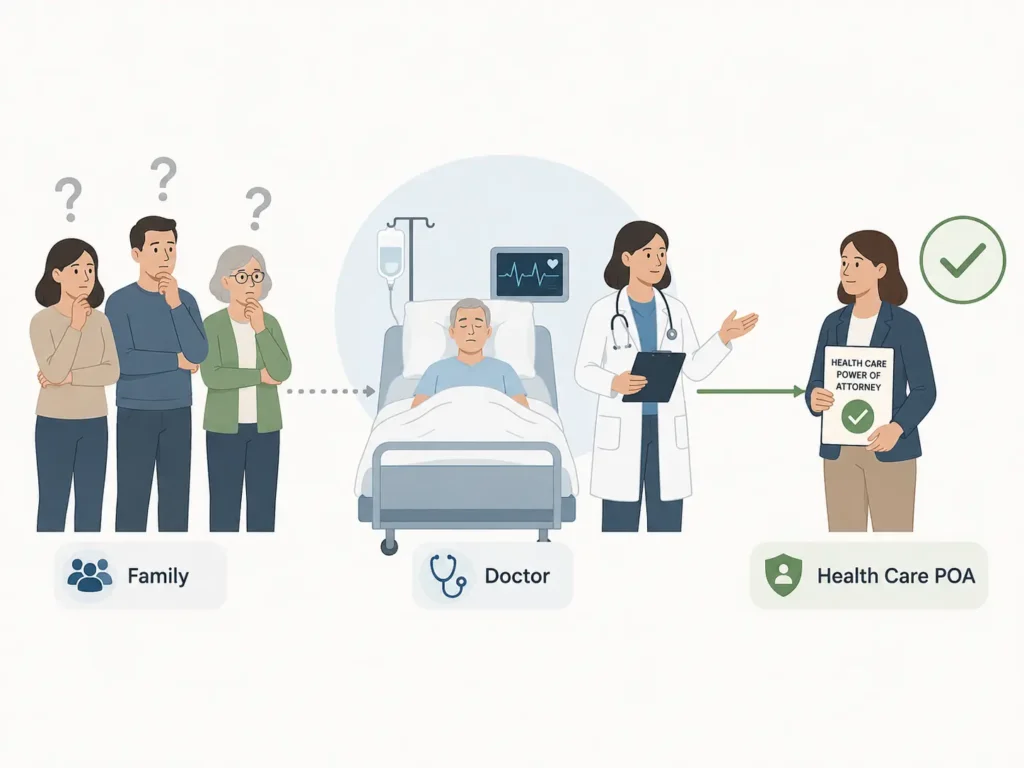
Financial management is only one part of incapacity planning. A person may be hospitalized, unconscious, under anesthesia, seriously ill, or no longer capable of understanding and communicating necessary medical decisions.
Doctors may need to determine whether to perform surgery, begin or stop a treatment, transfer the patient to another facility, or make another significant health care decision.
If no representative has been named, state law may allow a family member to make decisions for the patient. However, that does not necessarily make the process simple.
The person given that responsibility may face enormous pressure when making decisions that affect a loved one’s health or life. The situation can become even more difficult when family members disagree about the appropriate course of action.
What Is a Health Care Power of Attorney?
A Health Care Power of Attorney, sometimes called a Medical Power of Attorney or Health Care Proxy, allows a person to appoint someone to make medical decisions if they can no longer make or communicate those decisions personally.
The representative may need to speak with doctors, understand the patient’s condition, compare treatment options, consent to or refuse certain forms of care, and communicate the patient’s values and wishes to the medical team.
The best representative is not necessarily the oldest child or the person who lives closest. A suitable representative should understand your values, communicate clearly, remain calm under pressure, and be willing to carry out your wishes even when other family members disagree.
A Health Care Power of Attorney answers the question: Who will make medical decisions for me if I can no longer decide for myself?
What Happens if the Representative Does Not Know Your Wishes?
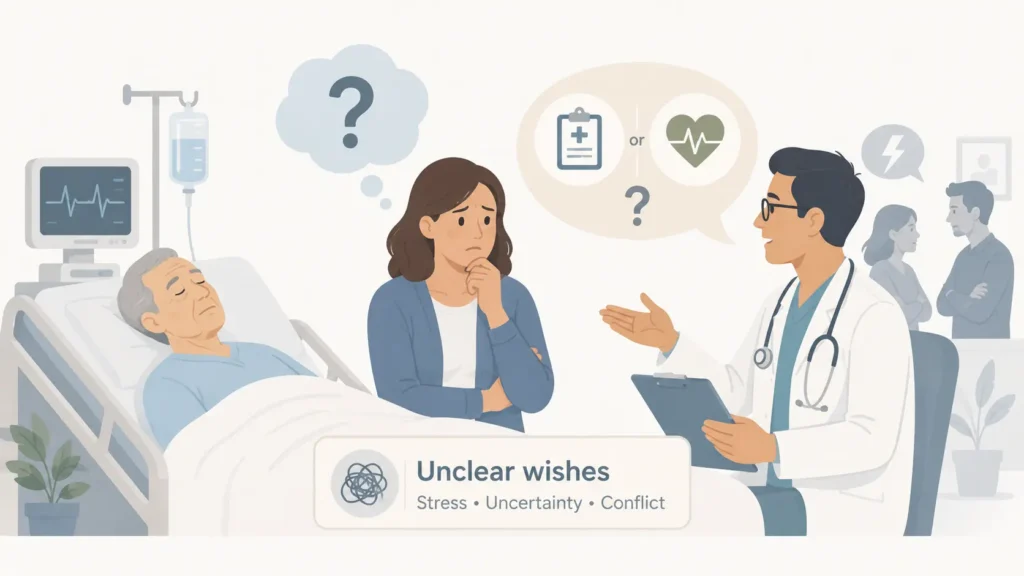
Appointing a health care representative solves only part of the problem. The person may have legal authority but still have no clear understanding of what you would want.
They may not know whether you would want every available treatment continued, whether you would want to remain on life-support equipment, or what level of recovery or quality of life would be acceptable to you.
When those wishes have not been clearly documented, the representative may feel anxious, guilty, or afraid of making the wrong choice. They may also have to defend the decision to relatives who disagree.
That can place a very heavy emotional burden on someone you care about.
What Does an Advance Health Care Directive Do?
An Advance Health Care Directive provides instructions about future medical care if a person can no longer communicate or make decisions. Depending on the state, the document may include or be connected with what is commonly called a Living Will.
An Advance Health Care Directive may address life-sustaining treatment, resuscitation, pain management, end-of-life care, and other personal medical preferences.
A Health Care Power of Attorney identifies who will make decisions. An Advance Health Care Directive helps explain what that representative and the medical team should consider when making those decisions.
No document can anticipate every possible medical situation. However, written guidance can help doctors and family members better understand the patient’s wishes while reducing confusion and emotional pressure on the person making decisions.
What Is the Role of a HIPAA Authorization or HIPAA Release?
Even when a health care representative has been appointed and medical wishes have been documented, that person still needs accurate information to make informed decisions.
They may need to know the diagnosis, treatments already provided, current medications, likelihood of recovery, existing risks, and available alternatives.
Medical information is protected by law. Under HIPAA, covered doctors, hospitals, health insurers, and other health care organizations must follow privacy requirements when using or disclosing protected health information.
A person should not assume that a spouse, child, or other relative automatically has unrestricted access to all medical information simply because the patient is ill. In some situations, a health care provider may share relevant information with family members or others involved in the patient’s care, but the scope of disclosure depends on the circumstances and the person’s legal authority.
Source: U.S. Department of Health and Human Services — Family Members and Friends under HIPAA
https://www.hhs.gov/hipaa/for-individuals/family-members-friends/index.html
A HIPAA Authorization or HIPAA Release is often used to identify the people or organizations permitted to receive certain protected medical information.
These three documents address different questions:
Health Care Power of Attorney: Who has authority to make decisions?
Advance Health Care Directive: What are my wishes?
HIPAA Authorization: Can the people helping me obtain the information they need?
Depending on state law and how the documents are drafted, some of these provisions may overlap or be combined.
What Happens to Your Assets After Death?
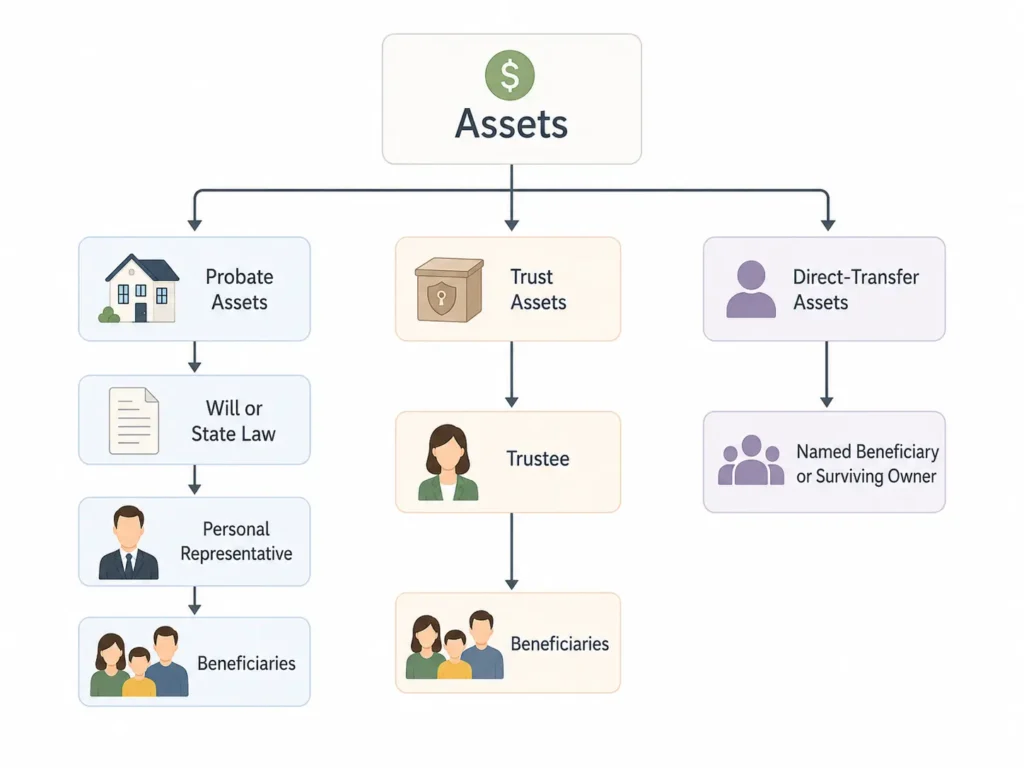
After someone dies, the family may need to secure the home and personal property, locate financial accounts, notify banks and other institutions, pay valid expenses, address real estate and tax matters, and eventually distribute the remaining assets.
The family may know that the deceased person verbally expressed certain wishes. However, verbal instructions may not provide sufficient legal authority or clear direction for administering an estate.
Without appropriate documents, several questions can quickly arise: Who is responsible? Who may work with the bank? Who receives each asset? Who pays the expenses? What happens if family members disagree?
Unclear arrangements involving money and property can delay the estate administration process and create conflict within the family.
What Does a Last Will and Testament Do?
A Last Will and Testament, commonly called a will, is a legal document that provides instructions for certain matters after a person’s death.
Depending on the person’s circumstances and state law, a will may identify beneficiaries, direct how certain assets should be distributed, nominate a personal representative or executor to administer the estate, and nominate a guardian for minor children.
The estate representative generally manages assets that pass through probate, identifies and protects estate property, handles valid expenses and claims, completes the required legal process, and distributes the remaining assets according to the will.
When someone dies without a valid will, that person is considered to have died intestate. State intestacy law then determines who receives the probate estate and who may be appointed to administer it.
The result may be similar to what the person wanted, but it may also be very different, especially in families involving stepchildren, unmarried partners, complex relationships, or intended beneficiaries who are not included under the default inheritance rules.
What Can a Revocable Living Trust Do?
A will may not always fully address a family’s goals for managing and distributing assets.
Children may still be minors. A beneficiary may not be prepared to manage a large inheritance. A person may want funds used for education, health care, or other important needs over several years. Assets may also need to be distributed gradually rather than transferred in full immediately after death.
A Revocable Living Trust is a legal arrangement created during a person’s lifetime to hold and manage assets according to written instructions. The person who creates the trust can usually continue controlling, using, and changing it while they remain capable.
The trust may also name a successor trustee who can take over management if the person who created the trust becomes incapacitated or dies.
Depending on how the trust is drafted and funded, it may help manage assets during incapacity, hold property for minor children or other beneficiaries, distribute assets in stages, and reduce the amount of property that must pass through probate.
An important point is that signing the trust document alone may not be enough. Appropriate assets may need to be transferred into the trust or otherwise coordinated with it. This process is commonly called funding the trust.
If a home, account, or other property remains outside the trust, the trust may not control it in the intended way. However, that does not mean every asset should automatically be transferred into a trust. Different assets may involve separate legal, tax, insurance, loan, or beneficiary-designation considerations.
Both creating the documents and properly implementing the plan are important.
Estate Planning Is Not Only About Preparing for Death
Estate planning addresses both situations that may occur during your lifetime and the responsibilities your family may face after your death.
A Financial Power of Attorney identifies who can manage finances. A Health Care Power of Attorney identifies who can make medical decisions. An Advance Health Care Directive records your care preferences. A HIPAA Authorization helps the appropriate people access necessary medical information. A will provides instructions for certain matters after death. A Revocable Living Trust may provide a broader structure for managing and transferring assets over time.
Not everyone needs the same documents or the same type of plan. A young unmarried person, a family with minor children, a business owner, and a retired couple with several properties may have very different estate planning needs.
The goal is not to accumulate as many legal documents as possible. The goal is to understand which problem each document is intended to solve, then coordinate with an estate planning attorney, tax professional, and financial professional to develop a plan that fits your circumstances.
Important notice: This article is for educational and general informational purposes only. It is not individualized legal, tax, or investment advice. Estate planning laws and procedures vary by state and depend on each person’s circumstances.