

Medicare is commonly known as the federal health insurance program for people age 65 and older. In practice, however, Medicare is not simply a matter of turning 65, choosing a plan, and beginning coverage.
Medicare decisions can affect retirement cash flow, taxes, Roth conversions, Social Security, investment withdrawals, and the timing of retirement. For that reason, Medicare should be viewed as part of a broader retirement plan rather than as a separate insurance decision.
When learning about Medicare, people will often encounter terms such as Medicare Part A, Part B, Part C, Part D, Original Medicare, Medicare Advantage, Medigap, and Medicare Supplement. Each has a different role, cost structure, and set of limitations.
What Is Medicare?
Medicare is a federal health insurance program primarily for people age 65 and older.
Some people under age 65 may also qualify if they have received disability benefits for a certain period or have specific medical conditions.
Medicare is sometimes confused with Medicaid, but they are different programs. Medicare eligibility is primarily based on age, disability status, or certain medical conditions. Medicaid is based more heavily on income and financial eligibility and is jointly administered by the federal government and individual states.
A person may have Medicare only, Medicaid only, or qualify for both programs.
Medicare is also not entirely free. Participants may face several types of costs, including premiums, deductibles, copayments, and coinsurance.
A premium is the amount paid regularly, usually monthly, to maintain coverage. A deductible is the amount a person generally pays before insurance begins paying according to the plan’s rules. A copayment is a fixed dollar amount paid when receiving certain services. Coinsurance is a percentage of the cost that the participant shares with the insurance program.
Understanding these terms is important because comparing Medicare options based only on the monthly premium can provide an incomplete picture.
How Is Medicare Funded?
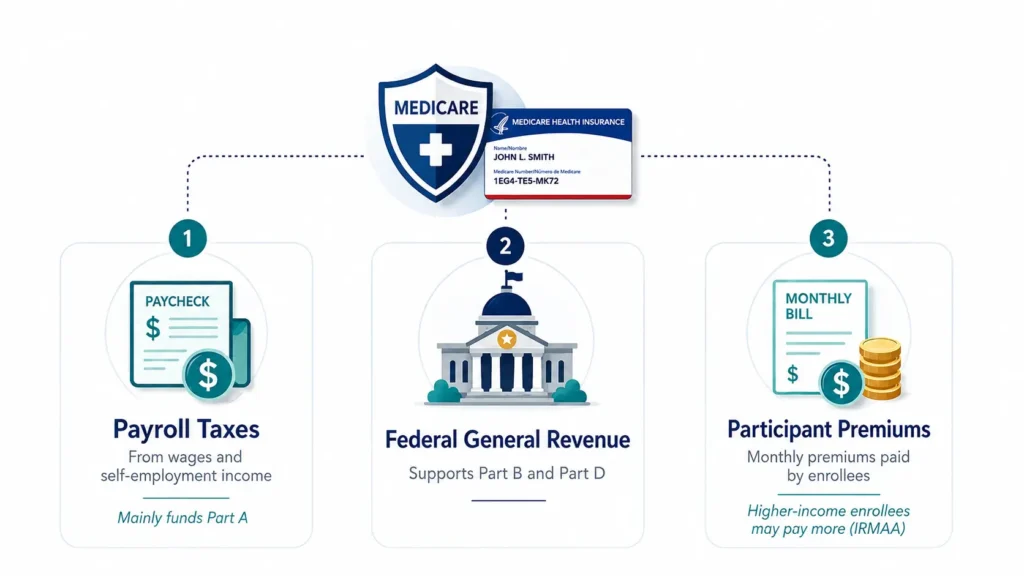
A significant portion of Medicare is funded through Medicare payroll taxes collected from wages and self-employment income.
For W-2 employees, the employee and employer each contribute toward Medicare taxes. Self-employed individuals generally pay both portions through self-employment taxes.
These taxes primarily help fund Medicare Part A.
This is also why most people who have worked and paid Medicare taxes long enough can receive Part A without paying a monthly premium. In general, this requires about 40 work credits, or roughly 10 years of work.
In some cases, a person who does not have enough work credits on their own record may qualify based on a spouse’s work history.
Medicare Parts B and D are funded primarily through federal general revenues combined with premiums paid by participants.
Higher-income Medicare beneficiaries may also pay an additional amount called the Income-Related Monthly Adjustment Amount, or IRMAA, for Part B and Part D.
What Is Medicare Part A?
Medicare Part A is commonly referred to as Hospital Insurance.
Part A primarily helps cover inpatient care, meaning the patient has been formally admitted to a hospital or other qualifying facility.
Coverage may include inpatient hospital stays, certain skilled nursing facility services, hospice care, some home health services, and inpatient rehabilitation when eligibility requirements are met.
Most people do not pay a monthly premium for Part A if they or their spouse have accumulated enough work credits.
However, that does not mean Part A has no out-of-pocket costs. Participants may still be responsible for deductibles and coinsurance.
It is also important to understand that staying in a hospital overnight does not automatically mean a patient has been admitted as an inpatient. If the patient is under observation status, some services may be billed under Part B instead of Part A.
What Is Medicare Part B?
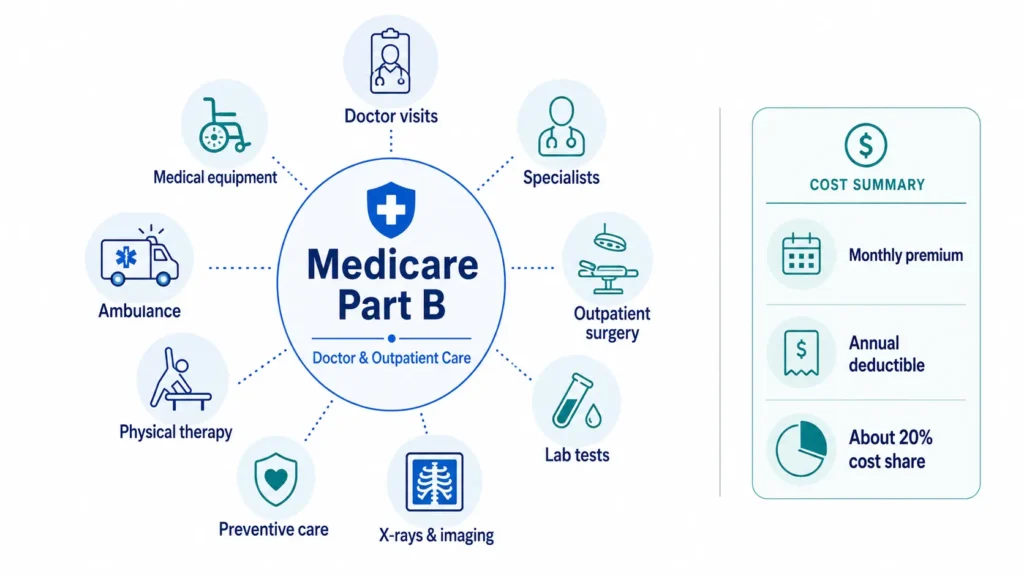
Medicare Part B is commonly referred to as Medical Insurance and primarily helps cover physician services and outpatient care.
Covered services may include physician visits, specialists, outpatient surgery, laboratory testing, diagnostic imaging, physical therapy, certain preventive services, ambulance transportation under qualifying circumstances, and certain durable medical equipment.
Unlike Part A, most participants pay a monthly premium for Part B.
That premium may be higher for individuals whose income exceeds certain thresholds because of IRMAA. The government generally uses Modified Adjusted Gross Income, or MAGI, from a tax return two years earlier when determining IRMAA.
If current income has dropped significantly because of retirement or another qualifying life-changing event, a beneficiary may be able to ask Social Security to reconsider the IRMAA amount.
Under Original Medicare, after the Part B deductible is satisfied, Medicare often pays approximately 80% of the Medicare-approved amount for many covered services, while the beneficiary is responsible for about 20%.
One important limitation is that Original Medicare does not have an annual out-of-pocket maximum for Part A and Part B expenses. For someone who uses a substantial amount of medical care, those costs can become significant.
What Is Original Medicare?
Original Medicare, sometimes called Traditional Medicare, consists of Medicare Part A and Part B.
Under Original Medicare, the federal government directly administers Medicare benefits.
Participants can generally receive care from doctors and hospitals throughout the United States that accept Medicare. This broader provider access can be useful for people who travel frequently or spend time in more than one state.
Original Medicare also has important limitations.
It does not generally include routine outpatient prescription drug coverage, does not pay all deductibles and coinsurance, and does not have an annual maximum on total out-of-pocket costs for Part A and Part B services.
Because of these gaps, many people with Original Medicare consider adding a separate Medicare Part D prescription drug plan and a Medigap policy to help cover some of the costs Original Medicare leaves behind.
What Is Medicare Part D?

Medicare Part D provides prescription drug coverage through private insurance companies approved by Medicare.
People using Original Medicare can purchase a separate Part D plan. Many Medicare Advantage plans already include Part D coverage.
Each Part D plan may have a different formulary, premium, deductible, pharmacy network, and cost-sharing structure.
Prescription drugs are also commonly divided into different tiers, with each tier potentially having its own copayment or coinsurance amount.
For that reason, it is usually not enough to choose a Part D plan simply because it has the lowest monthly premium.
A plan with a low premium may still result in higher total annual costs if it does not cover a person’s medications favorably.
When comparing Part D plans, it is helpful to consider the specific medications being taken, dosage, frequency, preferred pharmacies, and estimated total annual cost.
Part D is optional. However, delaying enrollment without other creditable prescription drug coverage may result in a late enrollment penalty later.
What Is Medicare Part C or Medicare Advantage?
Medicare Part C is another name for Medicare Advantage.
Medicare Advantage is not a separate benefit category in the same way as Part A, Part B, or Part D. Instead, it is an alternative way to receive Medicare benefits through a private insurance company approved by Medicare.
To enroll in Medicare Advantage, a person generally must have Medicare Part A and Part B and must continue paying the Part B premium.
The Medicare Advantage plan then administers Part A and Part B benefits. Most Medicare Advantage plans also include Part D prescription drug coverage.
Some plans may offer additional benefits such as dental, vision, hearing, gym memberships, or transportation benefits.
One important difference from Original Medicare is that Medicare Advantage plans have an annual out-of-pocket maximum for approved Part A and Part B services.
The tradeoff is that Medicare Advantage plans typically use provider networks and may require prior authorization for certain services, procedures, or treatments.
Two common types of Medicare Advantage plans are HMO and PPO plans. HMO plans typically require participants to use providers within the plan’s network and may require referrals to see specialists. PPO plans are generally more flexible and may allow out-of-network care, although at a higher cost.
What Is Medigap or Medicare Supplement?
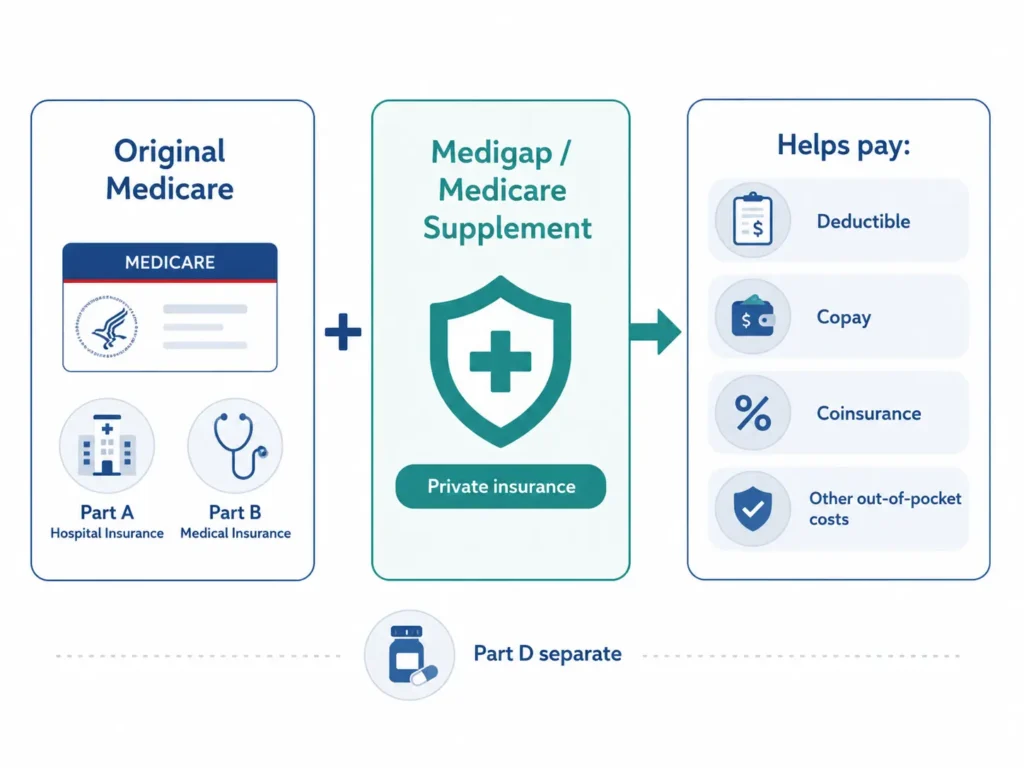
Medigap and Medicare Supplement refer to the same type of private insurance designed to work alongside Original Medicare.
Original Medicare may leave beneficiaries responsible for deductibles, copayments, and coinsurance. Medigap is designed to help cover some of these remaining costs.
Original Medicare remains the primary coverage. Medigap then helps pay certain amounts that remain according to the benefits of the policy.
Medigap does not replace Medicare and does not operate in the same way as Medicare Advantage.
To purchase Medigap, a person generally needs to have Medicare Part A and Part B. Medigap also does not include Medicare Part D, so people who use Original Medicare with Medigap typically purchase prescription drug coverage separately.
Medigap plans are identified by letters, such as Plan G or Plan N. The basic benefits of each lettered plan are standardized.
This means that if two different insurance companies both offer Plan G, the core benefits of those Plan G policies are generally the same. Differences are more likely to involve premiums, pricing methods, rate history, discounts, and customer service.
Medicare Advantage or Medigap?
There is no single answer that is appropriate for everyone.
Medicare Advantage often has a lower additional monthly premium. Some plans may even have a $0 additional plan premium beyond the Part B premium.
However, participants may pay copayments or coinsurance as they use medical services until they reach the plan’s annual out-of-pocket maximum.
Medigap usually has a higher monthly premium but may substantially reduce the amount a person pays when receiving covered medical services.
Therefore, comparing the two options should involve more than simply asking which plan has the lower premium.
Total cost, provider networks, prior authorization requirements, flexibility, travel needs, and expected use of healthcare services can all matter.
Another important consideration is that people should not automatically assume they can choose Medicare Advantage while healthy and simply switch to Medigap later if their health changes.
Medigap has an Open Enrollment Period that generally lasts six months and begins the first month a person is both age 65 or older and enrolled in Medicare Part B.
During this period, insurers generally cannot deny coverage or charge a higher premium because of health conditions.
After that period, depending on the state and individual circumstances, applying for Medigap may require medical underwriting. If a person does not have a guaranteed-issue right, the insurer may be able to deny the application.
For that reason, the initial Medicare decision should consider both current needs and the flexibility a person may want in the future.
When Can You Enroll in Medicare?
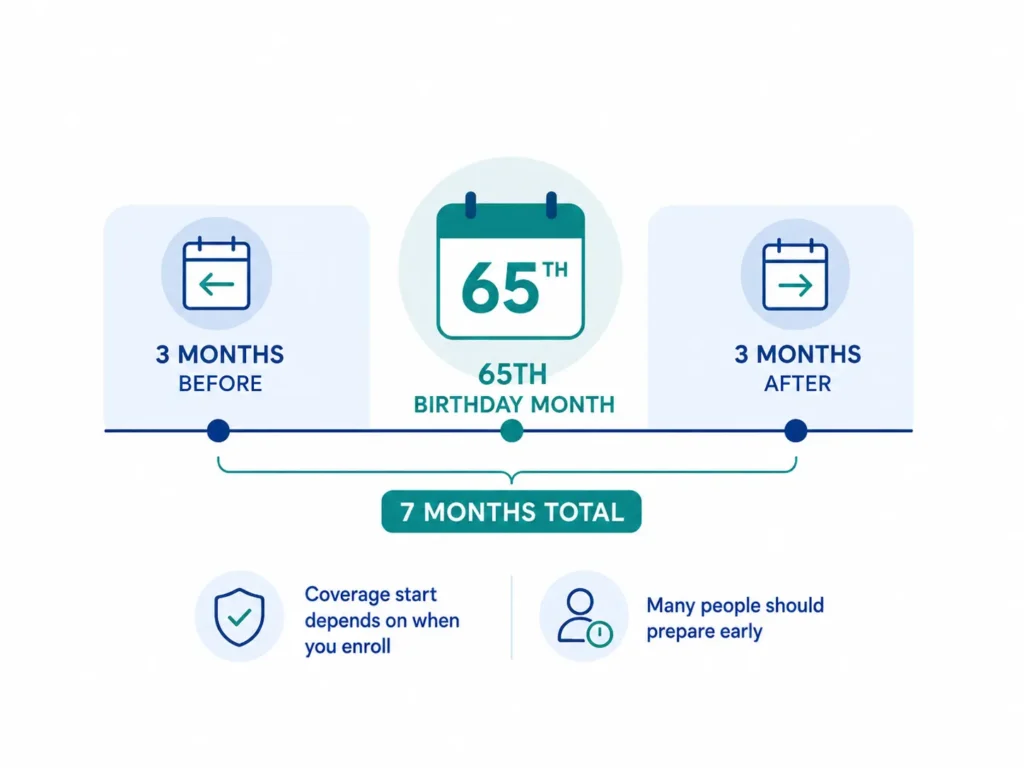
For most people, the first opportunity to enroll is the Initial Enrollment Period.
This period lasts seven months: the three months before the month of a person’s 65th birthday, the birthday month itself, and the three months after.
For example, if a person turns 65 in August, the Initial Enrollment Period generally begins May 1 and ends November 30.
Some people who are already receiving Social Security before age 65 may be automatically enrolled in Medicare Part A and Part B.
Those who are not receiving Social Security generally need to enroll proactively through the Social Security Administration.
It is also important to recognize that enrolling in Medicare and beginning Social Security retirement benefits are separate decisions. A person may enroll in Medicare at age 65 while delaying Social Security if that better fits the retirement plan.
What If You Are Over 65 and Have Not Enrolled in Medicare?
Whether delaying Medicare creates a problem depends largely on why enrollment was delayed and what type of health coverage the individual has.
If a person or spouse is still working and has qualifying employer health coverage from current employment, Part B may sometimes be delayed without a penalty.
When employment or qualifying coverage ends, there is generally a Special Enrollment Period of eight months to enroll in Part B.
If someone misses the Initial Enrollment Period and does not have qualifying current employment coverage, the person may need to use the General Enrollment Period, which runs from January 1 through March 31 each year.
Late enrollment can also lead to penalties.
The Part B late enrollment penalty is generally an additional 10% of the standard Part B premium for each full 12-month period the person was eligible but did not enroll.
This is generally not a one-time charge. It can be added to the monthly Part B premium for as long as the person has Part B.
Part D has a separate late enrollment penalty. A person who goes 63 consecutive days or longer without Part D or other creditable prescription drug coverage after becoming eligible may face an additional premium later.
How Medicare Fits Into Retirement Planning

Medicare should not be treated as a completely separate financial decision.
Medicare costs affect retirement cash flow. Income can affect IRMAA. Roth conversions can increase MAGI. The timing of retirement affects the transition from employer health insurance to Medicare. Social Security influences income, taxation, and portfolio withdrawal decisions.
When these elements are considered together, different retirement scenarios can be modeled and compared.
For example, a retirement plan might compare retiring earlier versus later, Medicare Advantage versus Medigap, different Roth conversion amounts, or how higher healthcare costs could affect future cash flow.
The goal is not simply to identify the plan with the lowest monthly premium. The more useful comparison considers total cost, benefits, restrictions, flexibility, and the tradeoffs associated with each option.
Conclusion
Medicare is a system made up of several different parts.
Part A primarily relates to hospital coverage. Part B primarily covers physicians and outpatient services. Part D provides prescription drug coverage. Medicare Advantage offers an alternative way to receive Medicare benefits through a private insurer.
Medigap works alongside Original Medicare to help cover some of the cost-sharing that Original Medicare leaves to the beneficiary.
There is no single Medicare arrangement that is appropriate for everyone. The decision may depend on healthcare needs, medications, preferred doctors, provider networks, travel, cost, flexibility, and long-term financial circumstances.
For that reason, Medicare should be considered as one component of a broader retirement strategy that also addresses cash flow, investments, taxes, Social Security, and the use of retirement assets.
This content is provided for general educational and informational purposes only. It does not provide Medicare, insurance, medical, tax, legal, or individualized financial advice.