

Many people, when they hear about the U.S. stock market, immediately associate it with risk, volatility, or even the idea that most people lose money.
This perception is not entirely unfounded. The stories that tend to circulate are often about losses—poor investment decisions, chasing news, emotional trading, or investing without fully understanding what is being purchased. For many individual investors, entering the market without a structured approach can lead to negative experiences, reinforcing the belief that the stock market is inherently unfavorable.
However, when viewed from a broader perspective, a different reality emerges. A significant portion of high-net-worth individuals and financially successful households in the United States maintain substantial exposure to equities. This raises an important question: if the stock market were simply a place where people lose money, why would it play such a central role in long-term wealth building?
The answer lies in understanding its true function.
The Fundamental Purpose of the U.S. Stock Market
At its core, the U.S. stock market is a financial system designed to connect two essential needs: the need for capital from businesses and the need for investment opportunities from individuals and institutions.
Throughout a company’s lifecycle, there comes a point where growth requires more capital than internal resources can provide. Early on, businesses may rely on retained earnings, personal capital, or debt financing. However, as they scale—whether by expanding into new markets, increasing production capacity, or building new infrastructure—the required level of capital often exceeds what can be sourced privately.
This is where the stock market becomes critical.
Rather than relying on a limited number of lenders or private investors, companies can raise capital from a broad pool of participants. This process often begins with an Initial Public Offering (IPO), where a company offers shares of ownership to the public for the first time.
When a company goes public, it is effectively making a trade-off: offering a portion of ownership in exchange for capital to support future growth. In return, investors gain the opportunity to participate in that growth over time.
This mechanism is what makes the U.S. stock market not just a place for trading securities, but a foundational component of economic expansion and capital allocation.
A Less Recognized Role: Converting Business Value into Liquidity
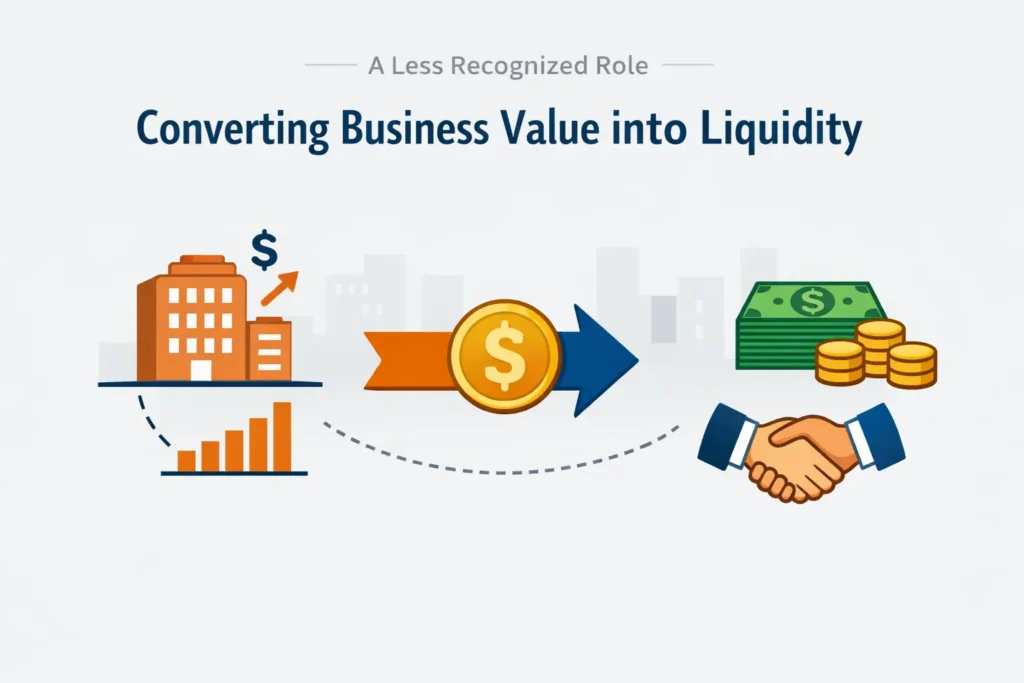
Beyond capital raising, the stock market serves another important function that is often overlooked: enabling business owners to gradually convert the value of their companies into liquidity.
For founders and entrepreneurs, a significant portion of their wealth is typically tied up within the business itself. While the company may be highly valuable, that value is not immediately accessible in cash form.
Without access to public markets, owners often face a binary choice—either retain full ownership or sell the entire company to a single buyer.
The U.S. stock market offers a more flexible alternative.
By going public, business owners can gradually sell portions of their ownership over time. This allows them to realize value without fully exiting the company, while still maintaining involvement if they choose. It also enables a more structured and efficient transfer of ownership across a broad base of investors.
This flexibility is a key reason why public markets play such an important role in long-term wealth management and business succession.
How Transactions Actually Work
One of the most common misconceptions about the stock market relates to how prices move. It is often assumed that when prices rise, it is because “everyone is buying,” and when prices fall, it is because “everyone is selling.”
In reality, market dynamics are more nuanced.
Every transaction in the market requires two parties: a buyer and a seller. When an investor places an order through a platform such as Robinhood or Charles Schwab, that order is routed to an exchange like the New York Stock Exchange or NASDAQ. A trade only occurs when another participant is willing to transact at the same price.
This leads to an important insight:
Even when a stock price is rising, there are still sellers willing to sell at that price. Conversely, when a stock price is declining, there are still buyers willing to purchase.
What changes is not the existence of buyers or sellers, but the price at which they are willing to transact.
As a result, stock prices reflect a continuous negotiation between market participants, rather than a one-sided movement driven by a single group.
Where Does Your Money Go When You Buy a Stock?

Another common question is whether the money used to purchase a stock goes directly to the company.
In most cases, it does not.
Capital flows directly to the company primarily during events such as IPOs or secondary offerings. Outside of these situations, the majority of transactions occur in the secondary market, where investors are buying and selling shares among themselves.
This means that when you purchase a stock, your money is typically transferred to another investor, not to the company itself.
However, this does not imply that market activity is irrelevant to the business. The stock price still plays a significant role in shaping a company’s financial position. A higher valuation can improve access to future capital, support mergers and acquisitions, and serve as a tool for employee compensation.
In this way, even indirect market participation contributes to the broader financial ecosystem surrounding the company.
How Investors Generate Returns
Investor returns generally come from two sources: dividends and capital appreciation. In practice, the majority of long-term returns are driven by price appreciation.
While some companies distribute profits through dividends, many—particularly those in growth phases—choose to reinvest earnings back into the business. This reinvestment can lead to higher future growth, which may be reflected in the stock price over time.
As a result, investors often benefit not from direct cash flows, but from an increase in the market’s valuation of the company.
Understanding this distinction is critical. Investing is not simply about whether a company is profitable today, but about how the market evaluates its future potential.
The Role of Expectations in Price Movement
Stock prices are heavily influenced by expectations about the future.
Each market participant forms their own view of a company’s value, based not only on current performance but also on anticipated growth, competitive positioning, and broader economic conditions.
When a company reports strong earnings or demonstrates growth potential, investors may be willing to pay a higher price in anticipation of future performance. Conversely, if expectations weaken—due to disappointing results or unfavorable macro conditions—prices may decline.
An important implication of this is that markets are forward-looking. A positive outcome does not always lead to a price increase if it was already expected. Similarly, a company with modest current performance can still experience strong price appreciation if investors believe in its long-term potential.
Recognizing the role of expectations helps investors interpret market movements more accurately and avoid reacting solely to headlines or short-term fluctuations.
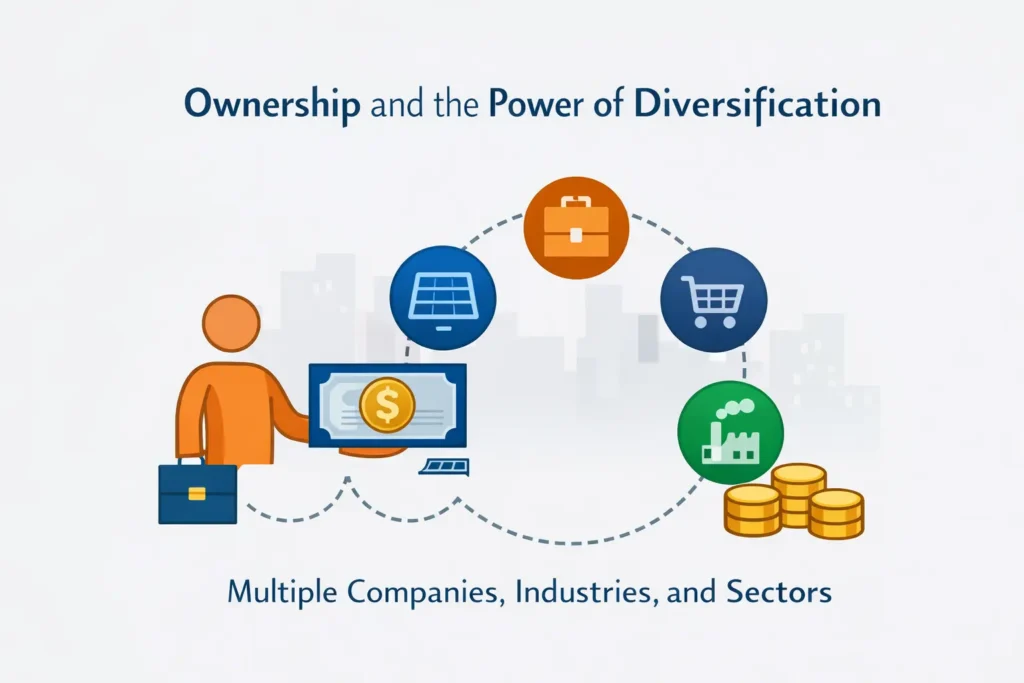
Owning a stock represents partial ownership in a real business. Even if the ownership stake is small, it links an investor’s financial outcome to the performance of that company.
However, the true advantage of participating in the U.S. stock market lies in the ability to diversify.
Unlike operating a single business, where income and risk are concentrated, investing in public markets allows individuals to allocate capital across multiple companies, industries, and geographies. This diversification reduces overall risk and creates a more stable foundation for long-term financial growth.
It enables investors to participate in a broad range of economic activities without needing to directly manage each underlying business.
A More Appropriate Perspective on Investing
A common mistake is to approach the stock market as a place to generate quick profits through short-term predictions. This often leads to decision-making driven by emotion, news cycles, or attempts to time the market.
In contrast, the U.S. stock market is fundamentally a long-term system. Value is built over time, through consistent participation in the growth of businesses and the broader economy.
Effective investing is less about predicting short-term price movements and more about structuring a disciplined approach to capital allocation.
When investors adopt this perspective, the focus shifts away from speculation and toward long-term strategy.
Conclusion
Understanding the U.S. stock market is the first step toward making more informed and confident investment decisions.
By recognizing how the market functions—how companies raise capital, how transactions occur, where returns come from, and how expectations shape prices—investors can develop a clearer and more logical framework for evaluating opportunities.
The stock market is not a game of chance. It is a structured financial system that connects capital with businesses and provides a pathway for long-term wealth creation when approached with discipline and clarity.