

When saving and investing for retirement, most Americans are familiar with accounts such as 401(k)s, traditional IRAs, and Roth IRAs. However, another type of account offers unique tax advantages that even traditional retirement accounts cannot fully replicate: the Health Savings Account (HSA).
An HSA does more than help pay for healthcare expenses. It can also serve as a long-term investment account, allowing individuals to build savings for future medical costs while benefiting from three distinct federal tax advantages, commonly known as the triple tax advantage.
However, not everyone qualifies to contribute to an HSA. Understanding the eligibility requirements, contribution limits, investment opportunities, and withdrawal rules is essential to making the most of this account.
1. What Is an HSA and How Does It Work?
A Health Savings Account (HSA) is a tax-advantaged savings account designed to help individuals pay for qualified medical expenses.
Although its name emphasizes healthcare savings, an HSA offers more flexibility than simply paying medical bills.
For example, someone with $3,000 in an HSA who incurs a $500 qualified medical expense can withdraw $500 without paying federal income tax on that distribution.
One important feature is that unused HSA funds do not expire at the end of the year. Instead, the remaining balance carries forward indefinitely.
Depending on the HSA provider, account holders may also invest their balances in mutual funds, exchange-traded funds (ETFs), or other available investments. This allows HSA funds to potentially grow over time, much like investments held in a 401(k) or IRA.
An HSA is also individually owned. If someone changes jobs, switches health insurance plans, or retires, the money already accumulated remains theirs.
2. Who Is Eligible to Contribute to an HSA?
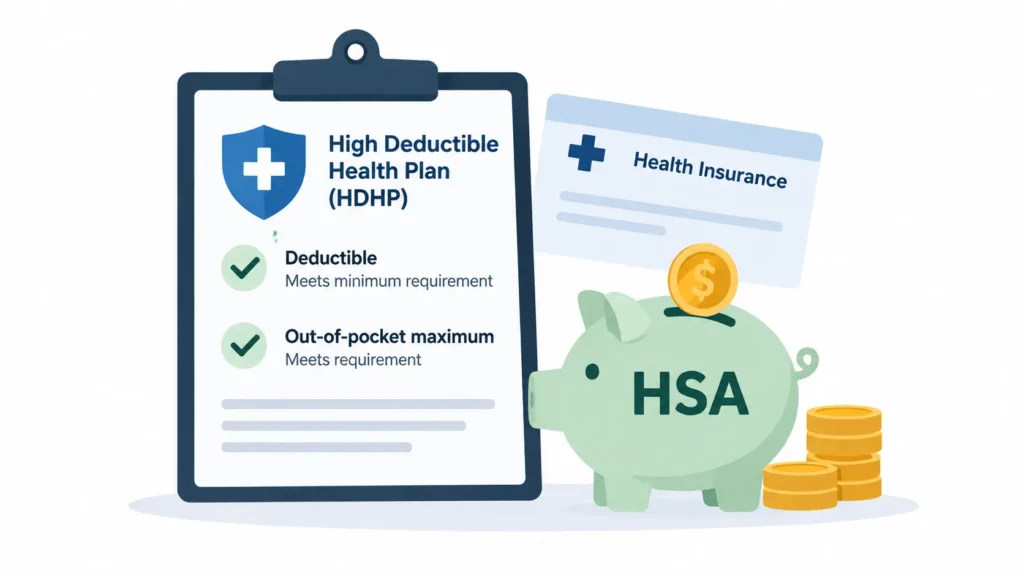
Under the traditional eligibility rules, individuals generally must be covered by an HSA-qualified High Deductible Health Plan (HDHP) to contribute to an HSA.
An HDHP is a health insurance plan with a relatively high deductible. The deductible is the amount an insured person generally pays for covered services subject to the deductible before the insurance plan begins sharing those costs.
For example, someone with a $3,000 deductible may need to pay eligible healthcare expenses out of pocket until that deductible is met. Certain preventive services may be covered before the deductible is satisfied.
HSA Eligibility Requirements for 2026
For 2026, the minimum annual deductibles under the traditional HDHP standards are:
- Self-only coverage: $1,700
- Family coverage: $3,400
Qualifying plans must also satisfy other requirements, including applicable out-of-pocket maximums.
Additional eligibility restrictions generally include not being enrolled in Medicare, not being claimed as another taxpayer’s dependent, and not having disqualifying additional health coverage.
However, certain types of supplemental insurance, including dental and vision coverage, may be permitted.
Individuals do not need employer-sponsored insurance to open an HSA. Self-employed individuals and those purchasing qualifying individual coverage may also be eligible.
Beginning in 2026, federal law also expanded HSA eligibility to certain additional health plans and arrangements. Therefore, eligibility should be confirmed based on the specific coverage and current regulations.
Source: IRS — Publication 969: Health Savings Accounts and Other Tax-Favored Health Plans
3. The Three Tax Advantages of an HSA
One of the most significant benefits of an HSA is its triple tax advantage.
First Advantage: Tax-Deductible Contributions
Eligible HSA contributions may be excluded from federal taxable income or deducted when filing a federal income tax return.
For example, suppose an individual earns $80,000 annually and contributes $4,000 to an HSA.
Assuming the entire contribution qualifies for a deduction, income before other adjustments and deductions could decrease from $80,000 to $76,000.
This can reduce the individual’s federal income tax liability.
Second Advantage: Tax-Free Investment Growth
Money invested within an HSA can grow without annual federal income taxes on investment earnings.
For example, if a $10,000 investment increases to $15,000, the $5,000 gain is not subject to annual federal income taxation while it remains in the HSA.
Investment returns are not guaranteed, and account values can decline.
Third Advantage: Tax-Free Withdrawals for Qualified Medical Expenses
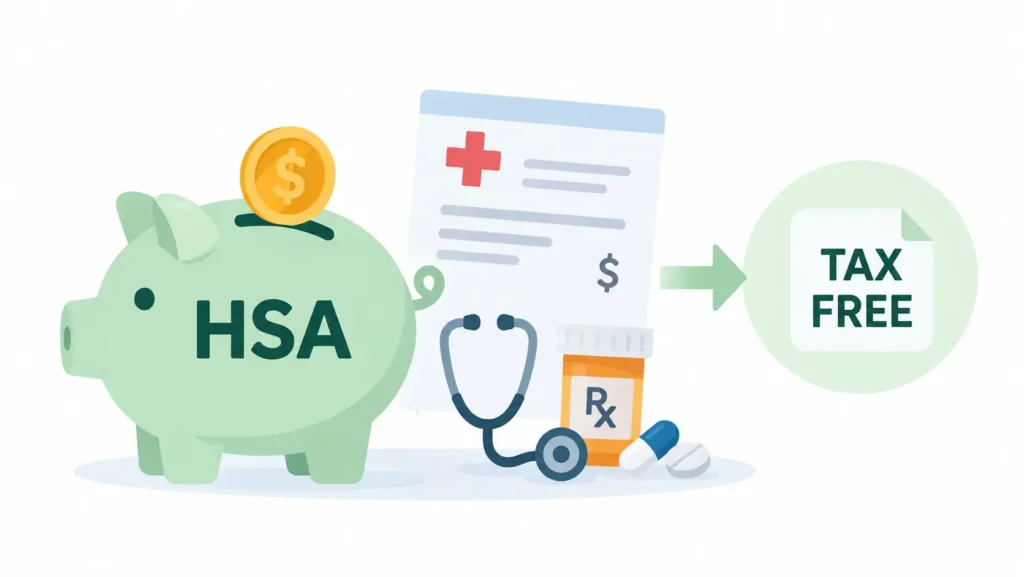
HSA distributions used for qualified medical expenses are generally exempt from federal income tax.
This distinguishes HSAs from many traditional retirement accounts.
With a traditional 401(k), eligible contributions generally reduce current taxable income, but withdrawals are typically taxable.
With a Roth IRA, contributions are made with after-tax money, while qualified withdrawals may be tax-free.
An HSA can combine both advantages when distributions are used for qualified medical expenses.
However, these benefits primarily concern federal taxes. States such as California and New Jersey have different tax treatments for HSAs.
4. HSA Contribution Limits for 2026
The IRS establishes annual HSA contribution limits.
| Coverage type | 2026 contribution limit |
|---|---|
| Self-only | $4,400 |
| Family | $8,750 |
| Catch-up contribution, age 55 or older | Additional $1,000 |
Eligible individuals age 55 or older can generally contribute an additional $1,000 annually.
These limits include both employee and employer contributions.
For example, if an individual’s annual limit is $4,400 and their employer contributes $1,000, the individual generally may contribute another $3,400.
For married couples with qualifying family coverage, the $8,750 basic family limit is shared rather than available separately to each spouse.
Each eligible spouse age 55 or older must make their catch-up contribution to an HSA in their own name.
Individuals eligible for only part of the year may be subject to prorated contribution limits, although certain exceptions apply.
Excess contributions that are not corrected within the applicable deadlines may be subject to a recurring 6% excise tax.
Source: IRS — Revenue Procedure 2025-19: HSA Contribution Limits for 2026
5. What Medical Expenses Can You Pay for With an HSA?
HSA funds can be used to pay qualified medical expenses for the account holder, their spouse, and eligible dependents.
Common qualifying expenses include:
- Doctor visits and medical treatments.
- Prescription medications and certain over-the-counter drugs.
- Dental care.
- Eye exams, prescription glasses, and contact lenses.
- Other medical services that meet IRS requirements.
However, not every health-related expense qualifies. For example, nutritional supplements and gym memberships used solely for general wellness typically do not qualify, although certain medical exceptions may apply.
Can You Use an HSA to Pay Health Insurance Premiums?
Monthly health insurance premiums generally cannot be paid tax-free using HSA funds.
Exceptions include COBRA coverage, certain health insurance premiums while receiving unemployment compensation, qualified long-term care insurance premiums, and certain premiums after age 65.
Qualified medical expenses must also be incurred after the HSA is established and cannot have been reimbursed by insurance or another source.
Account holders should retain receipts and supporting documentation to substantiate tax-free withdrawals if requested by the IRS.
Source: IRS — Publication 502: Medical and Dental Expenses
6. Should You Invest Your HSA or Use It for Current Medical Expenses?
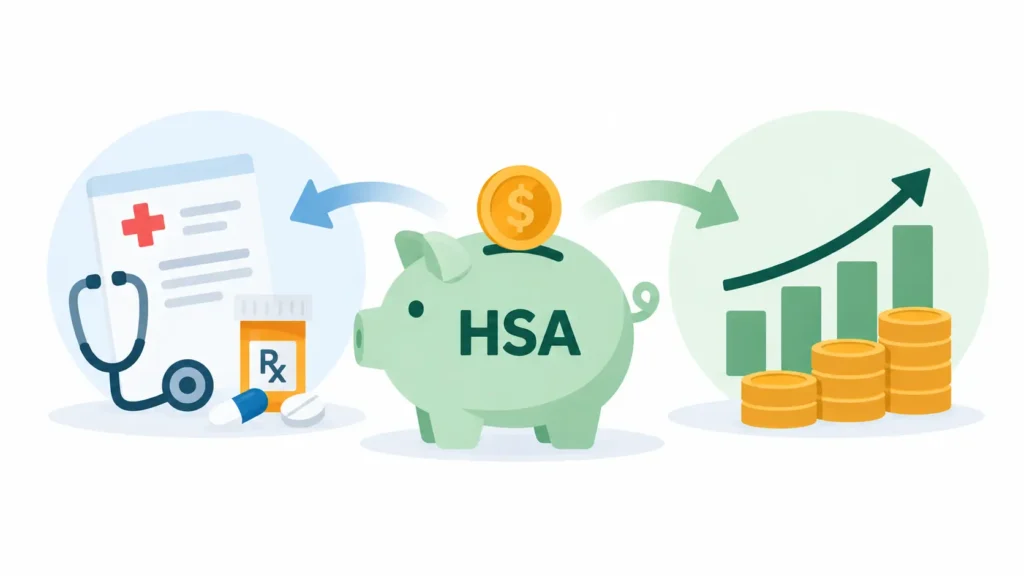
Many people contribute to an HSA and withdraw the funds to cover healthcare expenses during the same year. This is a reasonable approach, particularly for individuals with ongoing medical needs.
However, those who can afford to pay current healthcare expenses using other funds may choose to preserve and invest their HSA balance for long-term growth.
Example: The Potential Benefits of Investing
Suppose two individuals each have $10,000 in an HSA and do not need the money for 20 years.
The first person keeps the entire balance in cash. Ignoring interest, the account remains at $10,000.
The second person invests the money and earns a hypothetical 6% annual return. After 20 years, the account could grow to approximately $32,000.
This example illustrates compound growth, not a guaranteed or predicted investment return.
Paying Medical Expenses Now and Reimbursing Yourself Later
Another strategy involves paying current medical expenses out of pocket while preserving the HSA balance for investment.
Under federal rules, eligible expenses incurred after an HSA was established may be reimbursed later, provided they have not been reimbursed elsewhere and all applicable requirements are met.
For example, someone who pays $1,000 for qualified dental care and retains the receipt could potentially withdraw $1,000 from their HSA years later without federal income tax.
This approach allows the remaining HSA funds additional time to grow.
However, investing HSA funds is not appropriate for everyone. Individuals with limited emergency savings, frequent medical expenses, or short-term spending needs may face unnecessary investment risk.
The decision to invest or hold cash should reflect healthcare needs, investment time horizon, and risk tolerance.
7. How Can an HSA Help With Retirement Planning?
Healthcare expenses may become more significant with age. Costs associated with medical treatments, prescriptions, insurance, and long-term care can place additional pressure on retirement savings.
An HSA can help cover eligible expenses without requiring additional taxable withdrawals from traditional retirement accounts.
For example, suppose a retiree has both a traditional IRA and an HSA and needs $5,000 for qualified medical expenses.
Withdrawing $5,000 from a traditional IRA would generally create taxable income. Using $5,000 from an HSA for those expenses would instead allow a tax-free federal distribution.
This can help reduce reliance on taxable retirement withdrawals.
Another advantage is that HSAs are not subject to required minimum distributions (RMDs) during the account holder’s lifetime, unlike traditional IRAs and many 401(k) accounts.
What Changes at Age 65?
Before age 65, HSA withdrawals for nonqualified expenses are generally subject to ordinary income tax and an additional 20% tax.
Beginning at age 65, the additional 20% tax no longer applies.
Account holders can withdraw money for nonmedical purposes without that additional tax, although ordinary income tax still applies.
Withdrawals for qualified medical expenses remain federally tax-free, even after age 65.
This flexibility makes an HSA a potentially valuable component of retirement income planning.
8. How Does Medicare Affect HSA Eligibility?
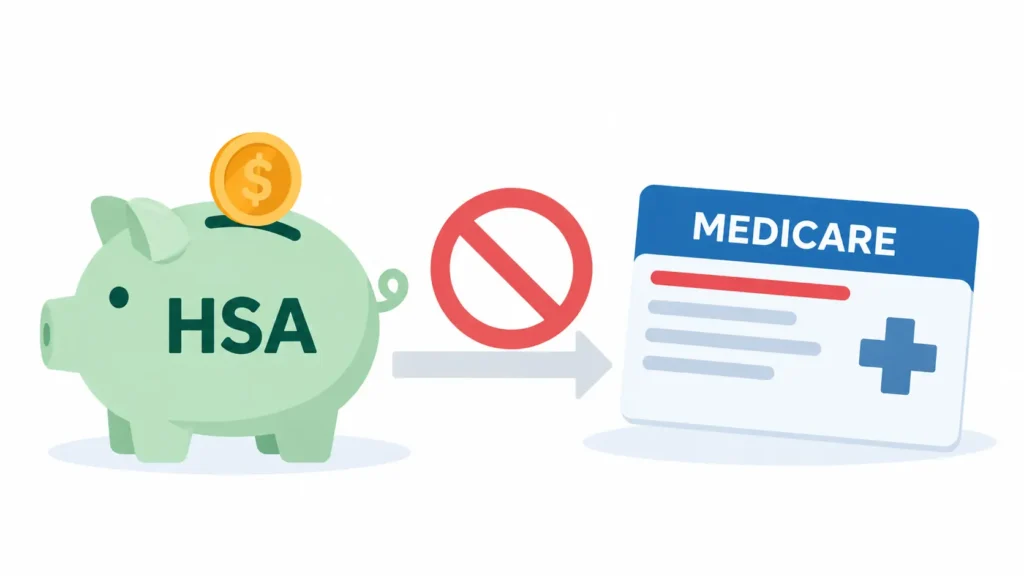
Once an individual enrolls in Medicare, including Medicare Part A, they generally become ineligible to contribute to an HSA for the months they have Medicare coverage.
However, previously accumulated HSA funds remain theirs and can continue to be used or invested.
After age 65, certain Medicare premiums, including Part B and Part D premiums, may qualify for tax-free HSA withdrawals.
Medicare Supplement insurance, commonly known as Medigap, does not qualify for this purpose.
Individuals who continue working after age 65 should carefully consider when to enroll in Medicare.
In some circumstances, Medicare Part A coverage can be retroactive for up to six months, but not earlier than the month an individual turns 65. This can affect whether recent HSA contributions were permissible.
Therefore, decisions about stopping HSA contributions, enrolling in Medicare, and claiming Social Security should be coordinated carefully.
Source: Medicare.gov — Health Savings Accounts and Medicare
9. Is an HSA-Eligible Health Insurance Plan Always the Best Choice?
Despite the attractive tax benefits, an HSA-eligible health insurance plan is not automatically the best option for everyone.
Consider two hypothetical employer-sponsored health plans:
| Plan A | Plan B | |
|---|---|---|
| Monthly premium | $500 | $300 |
| Deductible | Lower | Higher |
| HSA eligible | No | Yes |
Plan B saves $200 per month in premiums, or $2,400 annually.
If the employer also contributes $1,000 to the employee’s HSA, that represents an additional financial benefit.
However, individuals who require frequent medical visits, expensive medications, or specialized treatments may face substantially higher out-of-pocket costs under the higher-deductible plan.
When comparing health insurance options, it is important to evaluate total expected costs, including premiums, deductibles, copays, coinsurance, out-of-pocket maximums, provider networks, and prescription coverage.
Health insurance decisions should begin with healthcare needs and financial circumstances. HSA tax advantages should be considered as part of that evaluation rather than the sole deciding factor.
Conclusion: Incorporating an HSA Into a Long-Term Financial Plan
Retirement planning involves more than accumulating assets. It also requires determining how those assets will be used and how withdrawals may affect taxes.
An HSA can provide additional flexibility by setting aside funds for healthcare expenses while offering opportunities for tax-efficient investment growth.
However, its value depends on contribution strategies, investment decisions, withdrawal timing, and coordination with other retirement accounts.
A well-structured financial plan should consider these factors alongside an individual’s healthcare needs, financial resources, and long-term retirement objectives.