
Bonds are one of the most common types of investments, yet many investors do not fully understand how they work. Some people think bonds are similar to savings accounts, while others assume bonds are always safe. Some avoid them altogether because they seem too complicated.
Understanding bonds is useful not only because they provide another investment option, but also because bonds can play an important role in generating income, reducing portfolio volatility, and managing investment risk.
What Is a Bond?
The simplest way to understand a bond is this: a bond is essentially a loan.
When you buy stock in a company, you purchase a small ownership interest in that business. When you buy a bond issued by a company, however, you are not becoming an owner. You are lending money to the company and becoming one of its creditors.
For example, suppose a company wants to raise $100 million to build a new manufacturing facility. Instead of borrowing all of that money from a bank, the company can issue bonds and borrow from many different investors.
If you purchase $1,000 of that company’s bonds, the company essentially owes you $1,000 according to the terms of the bond.
Most bonds have several basic components.
Face value, also called par value, is the amount the issuer promises to repay when the bond matures.
Maturity date is the date when the bond comes due and the issuer is generally expected to repay the principal.
Coupon is the interest payment the issuer agrees to pay according to the bond’s terms.
For example, a bond with a $1,000 face value and a 4% coupon would generally pay $40 of interest per year. At maturity, the investor would receive the $1,000 principal back, assuming the issuer remains able to meet its obligations.
Source: Investor.gov — Bonds: FAQs
Why Do Governments and Companies Issue Bonds?
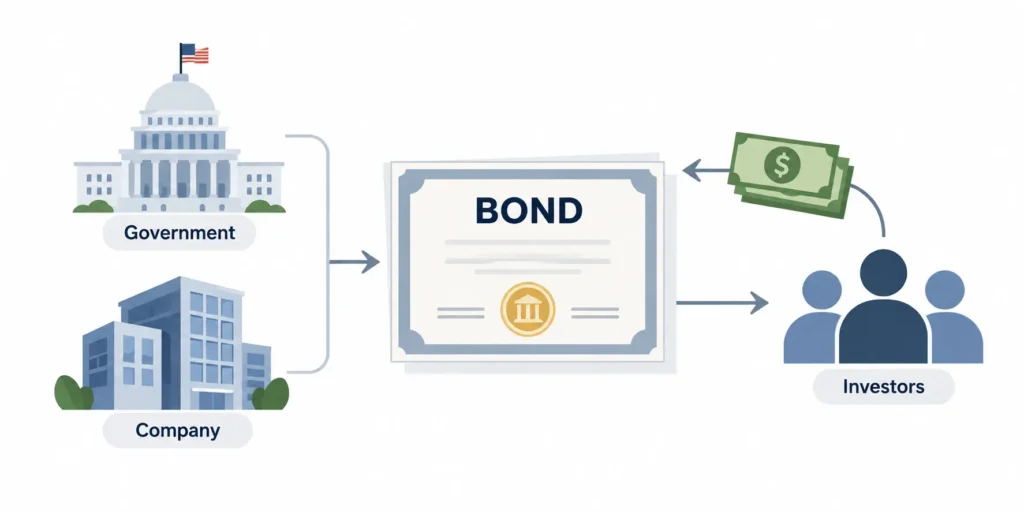
A simpler way to ask why an organization issues bonds is: Why does it need to borrow money?
Governments, municipalities, and corporations sometimes need large amounts of capital that they do not have available in cash.
The U.S. government issues Treasury securities to finance government operations and obligations. State and local governments may issue municipal bonds to fund projects such as schools, roads, and infrastructure.
Companies may issue corporate bonds to expand operations, purchase equipment, invest in new projects, refinance existing debt, or meet other financing needs.
Instead of borrowing only from a bank, an issuer can borrow from many investors. Each investor may lend a relatively small amount, but together those investments can provide a very large source of capital.
This also helps explain the relationship between interest rates and credit risk.
If a borrower is considered highly likely to repay its debt, it generally does not need to offer an unusually high interest rate to attract investors. If investors believe there is a greater chance they may not be fully repaid, they usually demand a higher return for taking that additional risk.
That is why a bond offering a higher interest rate is not automatically a better investment. The higher rate may simply be compensation for higher risk.
How Are Bonds Different From Stocks?
The easiest distinction to remember is:
Stocks represent ownership. Bonds represent debt.
If you buy stock in a company such as Apple, you own a small portion of that business. If the company grows, becomes more profitable, and investors value it more highly, the stock price may rise substantially.
The company is generally not required to buy your shares back on a specific date at a predetermined price. The price you receive when selling depends on what the market is willing to pay at that time.
A bond works differently. As a bondholder, you are a lender rather than an owner. The company or organization that issued the bond has contractual obligations to make interest and principal payments according to the bond’s terms.
If a company performs extremely well and its stock price triples, bondholders do not automatically participate in that growth.
On the other hand, if a company goes bankrupt, bondholders generally have a higher claim on the company’s assets than common shareholders. How much bondholders actually recover depends on the type of debt, its priority, and the company’s financial condition.
In simple terms, stock investors typically have greater exposure to the growth of a business, while bond investors are primarily focused on receiving the promised interest and repayment of principal.
Source: Investor.gov — Corporate Bonds
How Do Investors Make Money From Bonds?
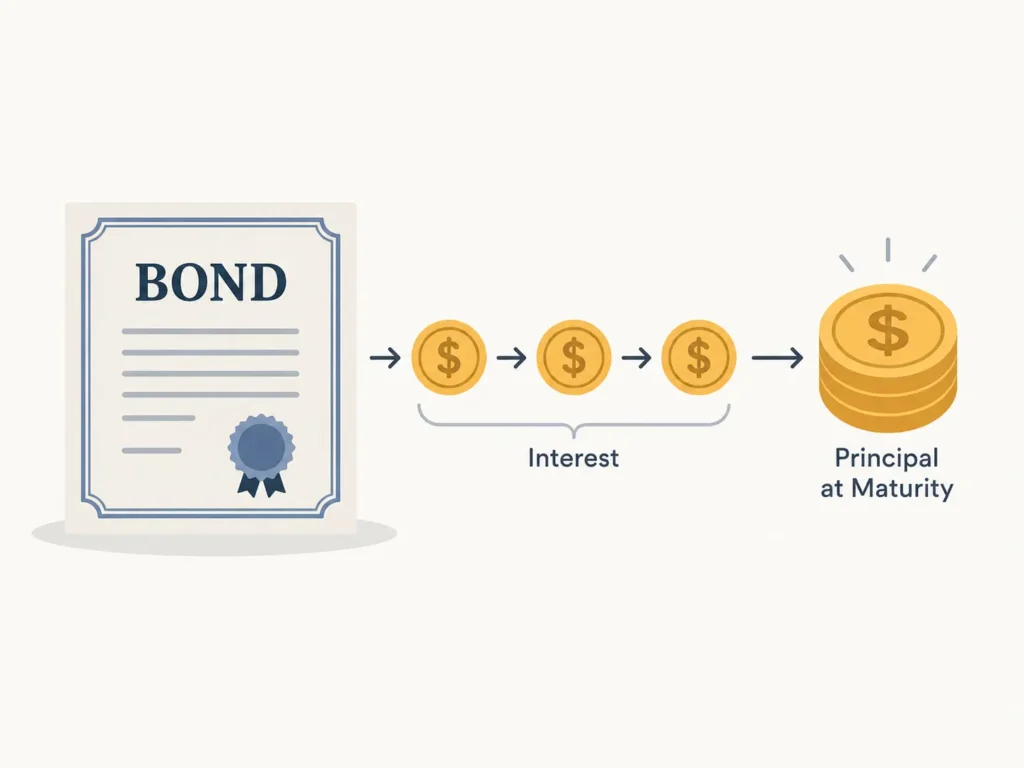
Bond returns can be understood in two main ways.
1. Interest Income
Suppose a bond has a $1,000 face value and a 4% coupon. It would generally pay about $40 of interest per year.
Many bonds make interest payments periodically, often twice a year. This is one reason bonds are commonly classified as fixed-income investments.
However, those payments still depend on the issuer being able to meet its financial obligations.
2. Yield and the Price You Pay
A bond with a $1,000 face value does not necessarily trade for exactly $1,000.
After a bond is issued, its market price can rise or fall. That makes the concept of yield important.
Suppose a bond has a $1,000 face value and pays a 4% coupon, or $40 per year.
If you buy the bond for $1,000, the $40 interest payment equals 4% of the amount you invested.
If you buy the same bond for $900, the same $40 payment represents approximately 4.4% of your purchase price. This is a simple way to understand current yield, which compares annual interest income with the bond’s current price.
If you hold that $900 bond until maturity and receive $1,000 back, the $100 difference between your purchase price and the face value also affects your overall return. When the calculation considers coupon payments, purchase price, and the amount repaid at maturity, it moves into the concept of yield to maturity.
The reverse is also true. If you pay $1,100 for the bond, the $40 annual interest payment represents only about 3.6% of your purchase price. If you receive only $1,000 at maturity, the $100 premium you paid also reduces your overall return.
This is why coupon rate, current yield, and yield to maturity are different concepts.
Source: U.S. Treasury — Understanding Pricing and Interest Rates
Are Bonds Really Safe?
Generally speaking, high-credit-quality bonds tend to have lower volatility and lower risk than stocks. This is one reason bonds are often used to help stabilize an investment portfolio.
However, lower risk does not mean no risk.
One major risk is credit risk, which is the possibility that the issuer may not make required interest or principal payments.
U.S. Treasury securities are generally considered to have very low credit risk because they are backed by the full faith and credit of the U.S. government. A corporate bond issued by a financially troubled company may carry considerably more credit risk.
Another major risk is interest-rate risk. When market interest rates change, the prices of existing bonds can rise or fall. If an investor needs to sell a bond before maturity, the sale price may be higher or lower than its face value.
Bonds also face inflation risk. A bond may continue paying a fixed amount of interest while the cost of living rises, reducing the purchasing power of those payments.
So bonds should not be viewed as risk-free investments. But higher-quality bonds can often serve as a more stable component of a diversified portfolio.
Source: Investor.gov — Bonds: Benefits and Risks
Common Types of Bonds

There are many types of bonds, but beginners can start by understanding a few major categories.
U.S. Treasury Securities
Treasury securities are debt obligations issued by the federal government.
Treasury Bills are short-term securities with maturities of one year or less.
Treasury Notes generally have intermediate maturities.
Treasury Bonds are longer-term securities.
Treasury Inflation-Protected Securities, or TIPS, are designed to provide protection against inflation by adjusting principal based on changes in inflation.
Source: U.S. Treasury — Treasury Marketable Securities
Corporate Bonds
Corporate bonds are issued by businesses.
Companies with greater credit risk usually must offer investors higher yields to compensate them for taking that additional risk. That is why investors should not evaluate a bond based solely on the interest rate it pays.
Municipal Bonds
Municipal bonds are generally issued by states, cities, or other government entities.
Interest from many municipal bonds may be exempt from federal income tax. In some cases, there may also be state or local tax advantages, depending on the bond and the investor’s circumstances.
Bond Mutual Funds and Bond ETFs
Many investors do not buy individual bonds directly.
Instead, they may own bonds through a bond mutual fund or bond ETF inside a 401(k), IRA, or brokerage account.
An individual bond has a specific maturity date. A bond fund may own hundreds or thousands of bonds and continuously manage the portfolio.
This distinction is important because owning a bond fund is not the same as holding one individual bond until maturity.
Why Bonds Matter in an Investment Portfolio
The purpose of bonds is not necessarily to produce the highest possible return.
Stocks often play a larger role in long-term growth, but they can also experience substantial price swings. Bonds may be used to generate income, reduce overall portfolio volatility, or keep a portion of assets at a more appropriate level of risk.
An investor who is 30 years away from retirement may view risk very differently from someone who is about to retire and begin withdrawing money regularly.
For a retiree, the question is not simply which investment has the highest expected return. It may also be important to consider what happens if the stock market falls sharply at the same time money is needed for living expenses.
Bonds can be one tool for managing that risk.
That does not mean older investors should move everything into bonds, or that younger investors never need them. An appropriate allocation depends on factors such as investment goals, time horizon, Social Security or pension income, withdrawal needs, and tolerance for market volatility.
Investors cannot control what markets will do tomorrow. They can, however, make decisions about how much risk they are willing to accept in their portfolios.
That is one of the most important roles bonds can play: not simply generating interest, but helping create a balance among growth, income, stability, and risk within a long-term financial plan.