
One of the most important retirement decisions many Americans face is deciding when to start claiming Social Security benefits.
If you claim at age 62, your monthly benefit can be about 30% lower than it would be at Full Retirement Age if your Full Retirement Age is 67. If you delay until age 70, your monthly benefit can be meaningfully higher.
If you look only at the monthly check, the decision can seem simple: the longer you wait, the more you receive.
But that is not the full picture.
There are situations where someone understands that claiming at 62 means a permanently lower monthly benefit and still decides to claim early. Depending on health, financial resources, family circumstances, investments, and retirement goals, that can still be reasonable.
Understanding Social Security Break-Even Analysis
One common way to compare claiming strategies is through a break-even analysis.
Assume your Social Security benefit at age 67 is $3,000 per month.
If you claim at 62, your benefit could be about $2,100 per month. If you wait until 70, it could be about $3,720 per month, before considering adjustments such as cost-of-living increases.
The person claiming at 62 receives benefits for eight years before the person waiting until 70 receives the first check.
At $2,100 per month:
$2,100 × 12 × 8 = $201,600
From age 70 forward, the person who waited receives about $1,620 more per month.
Dividing $201,600 by $1,620 gives a little more than 10 years. In this simplified example, the break-even age is around 80.
That number is useful, but it does not account for everything else happening in a retirement plan.
1. You Actually Need Social Security to Retire
The first reason is straightforward: you may genuinely need the income.
Some people reach age 62 and can no longer continue working because of health issues, a physically demanding job, a layoff, caregiving responsibilities, or simply because they are ready to retire.
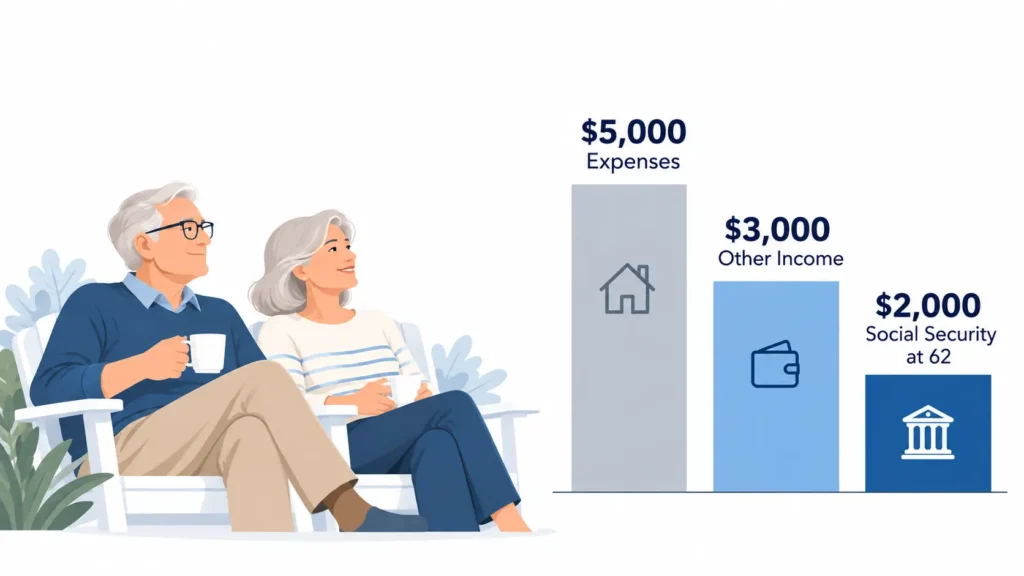
Suppose your monthly expenses are $5,000, but other retirement income only provides $3,000. If Social Security at 62 provides another $2,000 per month, that may be what makes retirement possible.
In that situation, the more practical question is not:
“How much more could I receive if I wait until 70?”
It is:
“How am I going to fund my life between age 62 and 70?”
Sometimes the most appropriate decision is not the one that maximizes Social Security. It is the one that allows the overall retirement plan to work.
2. Your Health or Life Expectancy Is Lower
One of the biggest advantages of delaying Social Security is that if you live a long time, you receive a larger monthly income later in life.
For someone in good health, with a family history of longevity and enough financial resources to delay, waiting can be valuable.
But if someone has a serious health condition or a reasonable basis for expecting a shorter life expectancy, receiving a smaller benefit earlier may make more sense.
Using the same example:
- $2,100 per month starting at age 62
- $3,720 per month starting at age 70
If benefits are received only through approximately age 80, the age-62 strategy provides:
$2,100 × 12 × 18 = $453,600
The age-70 strategy provides:
$3,720 × 12 × 10 = $446,400
At about age 80, the early claimant is still ahead by about $7,200 in cumulative benefits in this simplified example.
That is why life expectancy matters.
It is also important not to confuse life expectancy at birth with life expectancy for someone who has already reached their 60s. Health, family longevity, and personal circumstances can materially affect the decision.
3. Claiming Early May Reduce Pressure on Your Investment Portfolio
Another important question is often overlooked:
If you do not claim Social Security, where will the money come from while you wait?
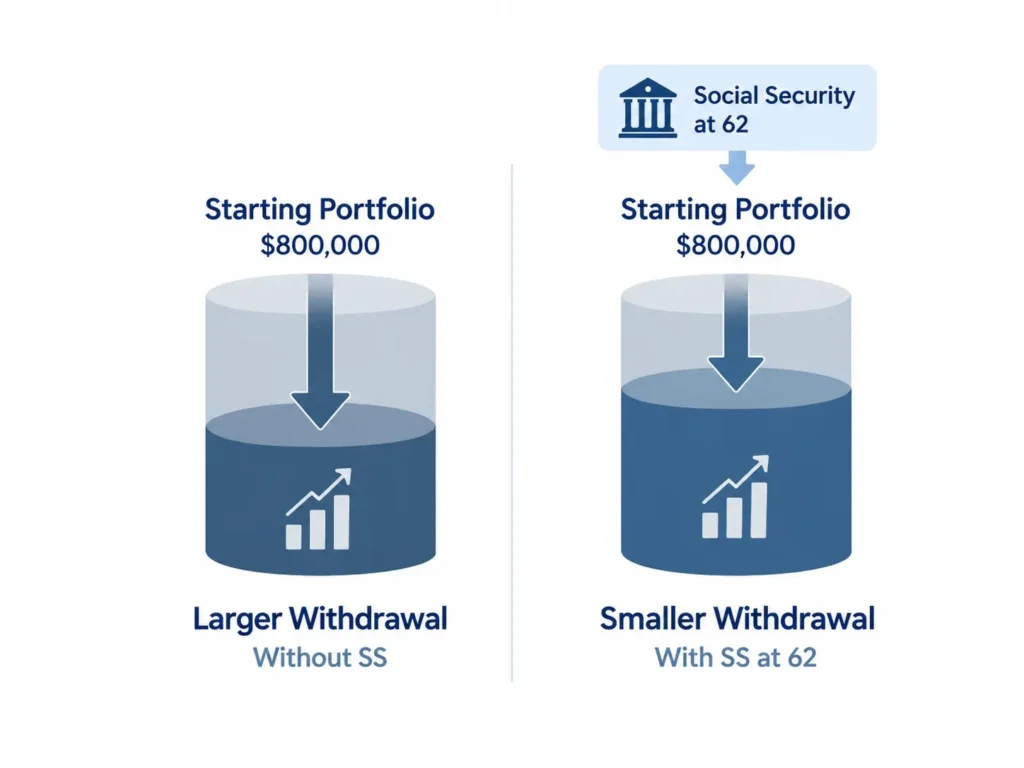
Suppose you retire at 62 with $800,000 across a 401(k), IRA, and taxable investment account.
If you delay Social Security until 70, you may need to withdraw a meaningful amount from those accounts for eight years.
If markets are strong, that may be manageable. But if you retire during a significant market decline and are forced to sell investments to fund living expenses, the impact can be more serious.
This is where sequence-of-returns risk becomes important. Large withdrawals early in retirement, especially during a market downturn, can make it harder for a portfolio to recover.
In some cases, claiming Social Security at 62 can provide cash flow and reduce the amount that must be withdrawn from investments.
That does not mean claiming early will automatically produce a better outcome. Investment returns are uncertain, while delayed Social Security provides a larger guaranteed monthly benefit.
The point is that the opportunity cost of using investment assets during the waiting period should also be considered.
4. Claiming Social Security May Unlock Benefits for Other Family Members
For some households, claiming Social Security affects more than just the worker.
It may also allow other family members to become eligible for benefits.
For example, in many situations, a spouse cannot receive a spousal benefit based on the worker’s Social Security record until the worker has filed for retirement benefits.
A retired worker may also have a child who qualifies for a child benefit if certain requirements are met.
That can change the analysis.
Looking only at the worker’s own benefit, delaying until 67 or 70 may appear better. But if filing earlier allows a spouse or child to receive additional family benefits, the overall household outcome may be different.
There are important rules surrounding these benefits, including eligibility requirements and the family maximum, so early filing should not be based on this factor alone.
5. There Is a Large Age or Life-Expectancy Gap Between Spouses
Social Security planning can become more complicated for married couples because both spouses need to be considered.
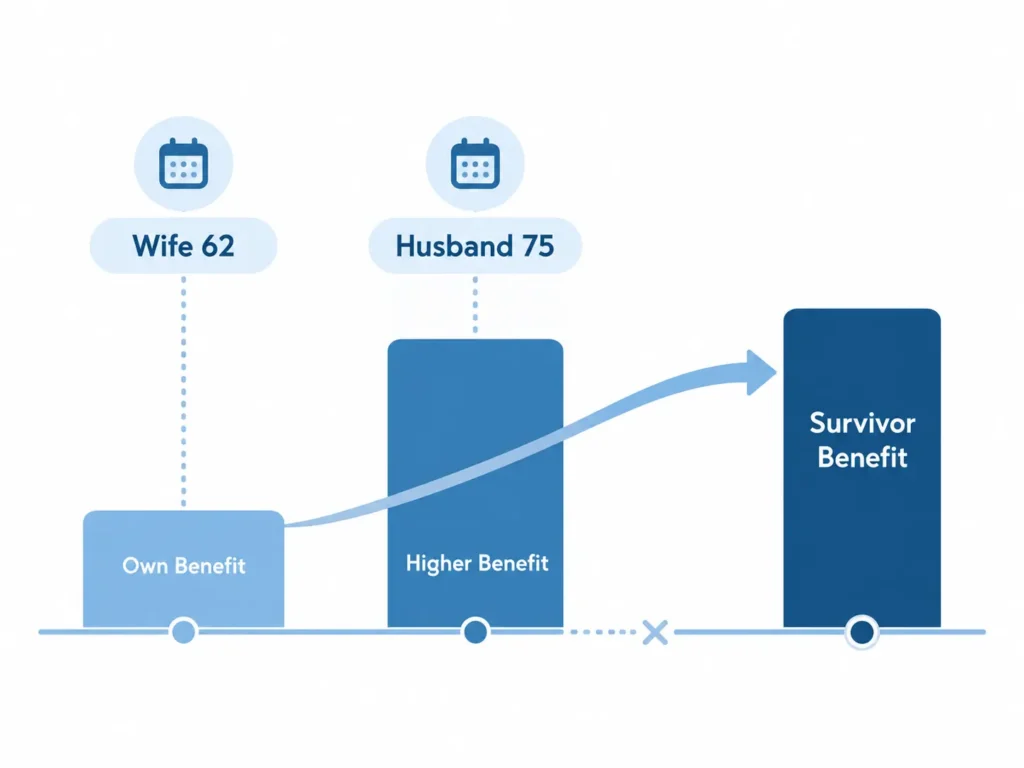
Suppose a 62-year-old wife has a relatively small Social Security benefit, while her 75-year-old husband is already receiving a much larger benefit.
If the husband dies first, the wife may eventually qualify for a survivor benefit if that amount is higher than her own.
Assume she begins receiving her own benefit at age 62.
Five years later, when she is 67 and her husband is 80, he dies. At that point, she may qualify to transition to the higher survivor benefit.
During those five years, she was able to receive her own Social Security benefit instead of waiting without receiving anything.
This does not mean every lower-earning spouse should claim at 62. It means Social Security decisions for married couples should often be evaluated at the household level.
6. You Already Have Enough Assets and Want More Income Earlier in Retirement
Not every retirement decision is about maximizing net worth.
Some people want to preserve and grow assets for heirs. Others may place greater value on using more of their resources during retirement.
Suppose you are 62, your home is paid off, you have a healthy investment portfolio, a pension or other income, and your retirement plan still works even with a smaller Social Security benefit.
The years between 62 and 70 may also be some of the years when you are healthiest and most active.
You may want to travel, spend more time with family, pursue hobbies, or do things you have delayed for years.
In that situation, someone may choose to claim Social Security earlier and use that income during a period when it creates more value in daily life.
The purpose of retirement planning is not always to finish life with the largest possible account balance. It may be to create a plan that allows money to support the lifestyle and experiences that matter most.
7. Claiming Early May Help You Avoid a More Harmful Financial Decision
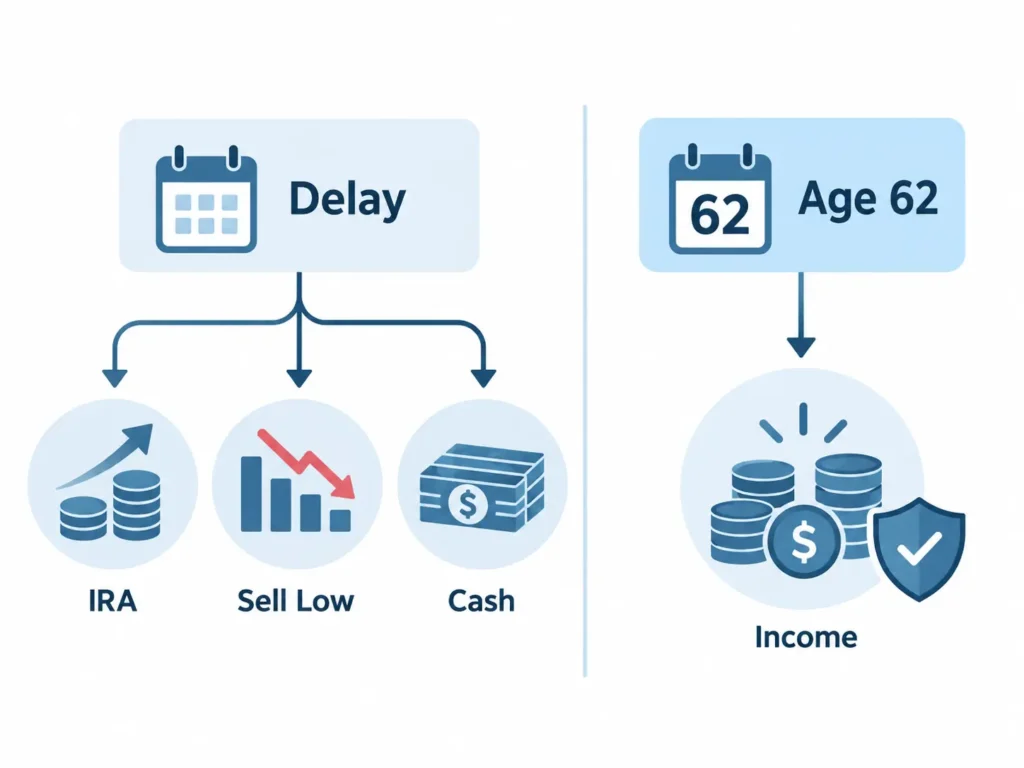
Suppose you need additional cash flow but still decide to wait until 70 because you know the future Social Security benefit will be larger.
The money to support your lifestyle during those waiting years still has to come from somewhere.
You may need to withdraw more from a 401(k) or IRA, sell investments during a market decline, spend down cash reserves too quickly, or continue working longer than you intended.
In that situation, comparing only $2,100 per month at age 62 with $3,720 per month at age 70 is incomplete.
You also need to consider the financial consequences of the alternative.
For example, an additional $30,000 or $40,000 IRA withdrawal may increase taxable income. Selling investments during a market decline may reduce the portfolio’s ability to participate fully in a later recovery.
Early retirement expenses can also be unpredictable. Home repairs, vehicle replacement, medical costs, or family support may require additional cash at inconvenient times.
Having another stable source of income from Social Security may provide greater flexibility.
Claiming at 62, 67, or 70 Is Really a Trade-Off Between Different Risks
One useful way to think about Social Security is that the claiming decision is not only about maximizing total dollars.
It is also about deciding which risks you are better positioned to handle.
If you delay Social Security, you are protecting yourself more strongly against longevity risk because you will have a larger monthly income later in life.
But you also have to fund more of your early retirement from cash, retirement accounts, investments, pensions, or other sources.
If you claim early, you receive cash flow sooner and may reduce pressure on other assets, but you accept a permanently lower monthly benefit.
That is what makes this decision difficult.
You do not know exactly how long you will live. You do not know how markets will perform. Your health, expenses, and family circumstances may change.
So the objective should not be to find one perfect claiming age for everyone.
The better goal is to choose a strategy that fits your financial situation and leaves enough flexibility for the retirement plan to continue working even if the future does not unfold exactly as expected.
Social Security is one source of retirement income. Its value depends not only on the size of the monthly check, but also on how it works together with your 401(k), IRA, pension, cash reserves, investment portfolio, family circumstances, and the kind of retirement you want to live.