


Social Security is an important source of retirement income for millions of Americans. Your monthly benefit depends on your earnings history, when you claim, and, in some cases, your marital history. Even if you have already started collecting benefits, there may still be opportunities to increase what you receive.
These seven strategies explain how Social Security benefits are calculated and which decisions may help improve your retirement income.
1. Work at Least 35 Years to Improve Your Benefit Calculation
Most workers need 40 Social Security work credits, generally earned over at least 10 years, to qualify for retirement benefits based on their own record. But qualifying for Social Security is different from maximizing your benefit.
The Social Security Administration (SSA) calculates retirement benefits using your highest 35 years of earnings, adjusted for changes in average wages. If you worked for only 20 years, the calculation includes 15 years with zero earnings, which can substantially reduce your monthly benefit.
For example, someone who took time away from the workforce to raise children or provide family care might have only 25 years of covered earnings by age 65. Working another five years could replace five zero-earning years and increase the benefit calculation.
Before retiring, review the number of earnings years recorded in your Social Security statement.
2. Replace Lower-Earning Years With Higher Earnings
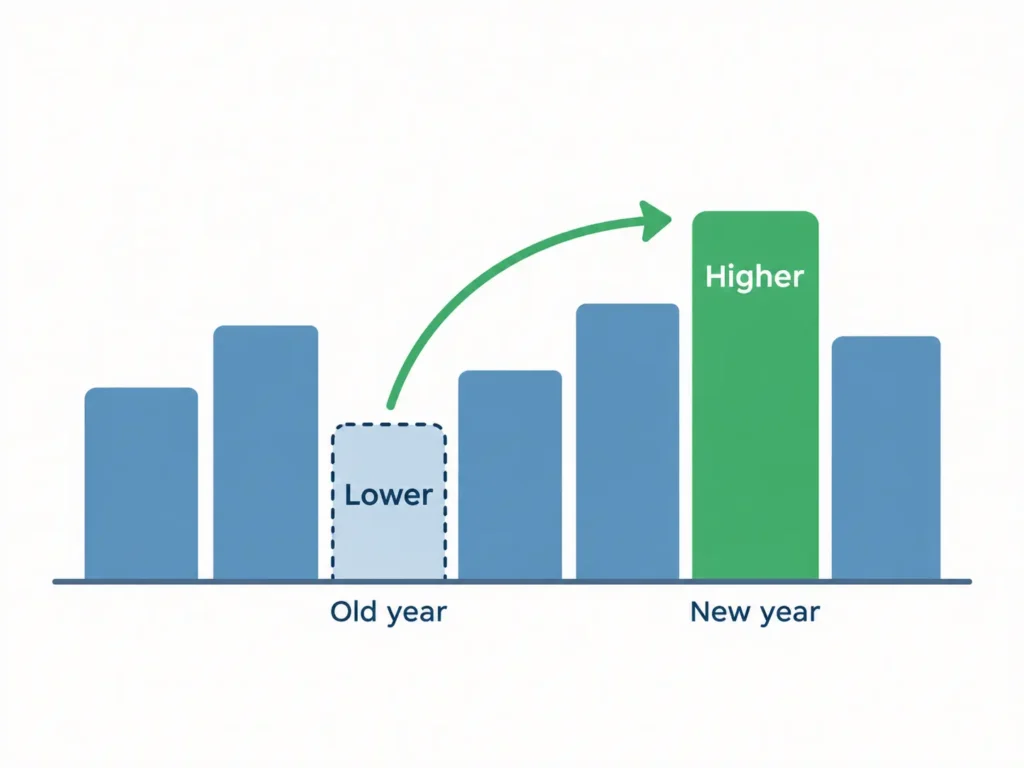
Even after working 35 years, additional employment may increase your benefit if a new year of earnings replaces a lower year among your highest 35.
Consider someone who earned $20,000 annually early in their career but now earns $80,000 to $90,000. Another year of higher earnings might improve their benefit. However, SSA adjusts past earnings using national wage trends, so comparing historical salaries directly with today’s dollars can be misleading.
The benefit formula is also progressive: an increase in average earnings does not create an equal percentage increase in benefits. If your 35 highest years are already relatively strong, working longer may produce only a modest improvement.
There is also a limit on earnings counted for Social Security. In 2026, the maximum taxable earnings amount is $184,500. If you earn $250,000, the amount above $184,500 does not further increase your Social Security earnings record for that year.
Source: Social Security Administration — Your Retirement Age and When You Stop Working
3. Choose the Right Age to Claim Social Security
When you start benefits can make a major difference in your monthly payment. Retirement benefits can generally begin at age 62, but your full retirement age (FRA) depends on your birth year. For people born in 1960 or later, FRA is 67.
Claiming before FRA reduces your monthly benefit. Waiting beyond FRA increases it through delayed retirement credits, generally at 8% per year until age 70.
Suppose your monthly benefit at age 67 would be $2,000:
- Claim at 62: About $1,400 per month, a 30% reduction.
- Claim at 67: $2,000 per month.
- Claim at 70: About $2,480 per month, a 24% increase over age 67.
That is a difference of $1,080 per month, or $12,960 per year, between claiming at 62 and 70. These are simplified examples that exclude future cost-of-living adjustments.
However, a larger monthly check does not automatically mean a better overall outcome. Someone who delays until 70 gives up years of earlier payments. Health, life expectancy, other income, available savings, and the effect of withdrawals from investments all matter.
For a closer look at why claiming Social Security at age 62 can sometimes make sense, it helps to compare the full financial trade-offs rather than just monthly benefit amounts.
Source: Social Security Administration — Starting Your Retirement Benefits Early
4. Understand Spousal Social Security Benefits

Spousal benefits can be valuable when one spouse earned substantially more than the other or when one spent years outside the paid workforce.
If eligible, a spouse may receive up to 50% of the worker’s full retirement age benefit. For example, suppose one spouse is entitled to $3,000 per month at FRA. The other spouse’s own retirement benefit is only $900 at FRA. A full spousal benefit could bring the lower earner’s total payment to $1,500 per month—an increase of $600, not an additional $1,500 on top of $900.
Generally, the worker must have filed for retirement or disability benefits before the spouse can collect on that record. Claiming spousal benefits before FRA usually reduces the amount.
Importantly, the maximum spousal benefit is generally based on the worker’s FRA benefit, not an increased amount from delaying until 70. A worker whose benefit rises from $3,000 to $3,720 by waiting does not thereby raise the maximum spousal benefit to $1,860.
Divorced individuals may also qualify based on a former spouse’s record if the marriage lasted at least 10 years and other requirements are met. The former spouse may not need to have filed yet in certain circumstances, and these benefits do not reduce their payments.
Source: Social Security Administration — Do You Qualify for Social Security Spouse’s Benefits?
5. Consider Survivor Benefits When Planning as a Couple
When a spouse dies, the surviving spouse may qualify for survivor benefits based on the deceased spouse’s earnings record. These benefits follow different rules from regular spousal benefits.
Imagine a couple receiving $3,200 and $1,200 per month, respectively—a combined $4,400. After the higher-earning spouse dies, the survivor does not keep both checks. If eligible for the full survivor amount, the remaining spouse may receive approximately $3,200 per month rather than their previous $1,200.
Survivor benefits can often start at age 60, but beginning early generally reduces them. The full retirement age for survivor benefits can also differ from the retirement FRA.
This is one reason delaying benefits for the higher-earning spouse may protect the surviving spouse later in life. Someone eligible for both their own retirement benefit and survivor benefits may also be able to claim one first and switch to the other later when appropriate. The two payments are not simply added together.
Source: Social Security Administration — What You Could Get From Survivor Benefits
6. Increase Benefits Even After You Start Collecting

Starting Social Security does not necessarily lock your payment at the same amount forever, apart from annual cost-of-living adjustments.
Continue working. SSA reviews earnings records and may recalculate your benefit if recent covered earnings replace a lower year in your highest 35. But if you are receiving benefits before FRA, the retirement earnings test may temporarily reduce payments.
For 2026, the earnings-test rules are:
- Under FRA all year: The limit is $24,480. SSA withholds $1 in benefits for every $2 earned above it.
- Reaching FRA during the year: The limit is $65,160 for earnings before the month you reach FRA. SSA withholds $1 for every $3 above that limit.
- Beginning the month you reach FRA: No earnings-test limit applies.
For example, someone age 63 who earns $34,480 in 2026 is $10,000 above the lower threshold and may have $5,000 in benefits withheld. At FRA, SSA adjusts the benefit calculation to account for months when benefits were withheld; it does not simply return the entire amount in one payment.
Withdraw your application. If you recently started benefits and reconsider, you may be able to withdraw your application within 12 months after approval, generally only once. You must repay benefits already paid, including applicable amounts paid to family members or withheld for other purposes.
Voluntarily suspend benefits. After reaching FRA and before age 70, you can request a suspension to earn delayed retirement credits. This can increase future payments, but it does not fully erase reductions from an earlier claiming decision. Suspending may also affect benefits paid to family members on your record.
Source: Social Security Administration — Receiving Benefits While Working
Source: Social Security Administration — Cancel Your Benefits Application
7. Review and Correct Your Social Security Earnings Record
One of the simplest potential improvements requires no additional years of work: making sure SSA has recorded your earnings correctly.
Suppose a year in which you earned $70,000 was mistakenly omitted from your record. If it should have been included among your highest 35 years, the error could lower your benefit.
Review your record through a my Social Security account. Look for years with zero earnings or amounts that seem unusually low. Forms W-2, tax returns, and pay stubs may help document discrepancies when requesting a correction.
SSA generally applies a time limit of three years, three months, and 15 days after the relevant tax year for correcting earnings, but certain exceptions allow later corrections. Checking regularly can make errors easier to resolve.
Not every type of income counts toward retirement benefits. Investment gains, interest, and many rental-income payments generally are not Social Security-covered wages.
Also review the assumptions behind your online benefit estimate. If it assumes you will keep working but you plan to retire earlier, adjusting expected future earnings can give you a more useful projection.
Source: Social Security Administration — How Do I Correct My Earnings Record?
Social Security Should Be Part of Your Overall Retirement Strategy
Maximizing your Social Security check is not always the same as maximizing your financial security. Waiting until 70 may provide more monthly income later, but it could also require larger withdrawals from a 401(k), IRA, or investment account during the years you wait. Those withdrawals may affect taxes, cash flow, and long-term portfolio sustainability.
Claiming early can reduce pressure on investments in the near term, but it means accepting a lower monthly benefit for life. Married couples must also consider what happens to household income after one spouse dies.
Ultimately, the goal is not simply to collect the highest possible Social Security payment. It is to coordinate benefits, savings, taxes, investments, and spending within a broader retirement income strategy. Thoughtful financial and investment guidance can help evaluate those trade-offs in the context of your own goals and resources.