

Who This Is For
This guide is written for early- to mid-career professionals who are focused on building their careers, managing a busy lifestyle, and trying to make smart financial decisions—without feeling overwhelmed by complexity.
If that sounds like you, keep reading.
When You’re Young, Investing Doesn’t Feel Urgent
When you’re early in your career, investing for individuals rarely feels like a top priority.
You may not yet have significant financial responsibilities. Retirement feels distant. Life is filled with new experiences—career growth, relationships, travel, skill development, and personal discovery.
Naturally, long-term financial planning can feel abstract.
And that’s completely understandable.
I don’t blame anyone for not making money their main focus in their 20s—I was exactly the same. At that stage of life, patience is difficult. We’re wired for instant gratification: quick wins, fast results, immediate rewards.
Unfortunately, investing doesn’t reward impatience.
Higher returns often come with higher risk. Short-term thinking frequently leads to emotional decisions. And emotional decisions can become expensive lessons.
But here’s a truth most people only realize later:
How you do one thing is often how you do everything.
If you can build the habit of investing early—even in small amounts—you’re not just growing money. You’re developing discipline, long-term thinking, and consistency.
And those habits compound just like your investments do.
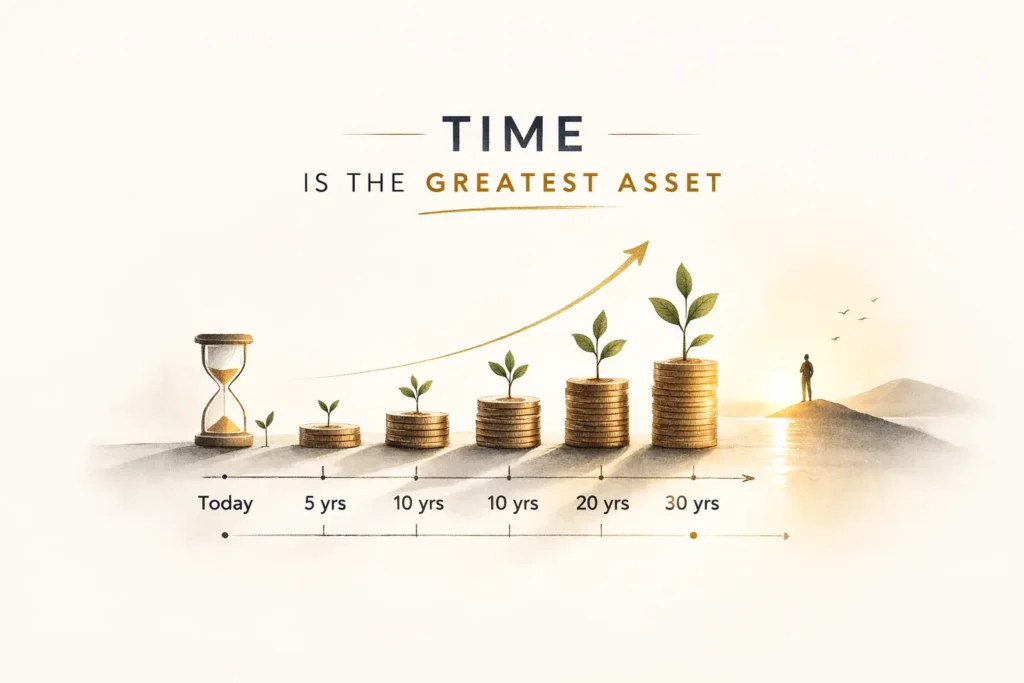
The Power of Starting Early: Time Is Your Greatest Asset
When we talk about investing early, we’re really talking about one powerful force:
Time.
Time is the most valuable advantage you will ever have in investing.
Starting early allows compound growth to do the heavy lifting. Compounding means your returns begin generating returns of their own. Over decades, this effect becomes exponential.
The difference between starting at 25 versus 35 can be hundreds of thousands of dollars—or more—by retirement. Not because you invested dramatically more, but because you gave your money more time to grow.
For individuals building toward financial independence and retirement, time creates leverage. And leverage reduces pressure later in life.
When you start early:
- You can invest smaller amounts consistently.
- You don’t need to take excessive risk to “catch up.”
- Market volatility becomes less intimidating.
- You gain flexibility in career and lifestyle decisions.
Investing for individuals isn’t about chasing high returns. It’s about positioning yourself intelligently for long-term freedom.
Why Many Individuals Delay Investing
Despite knowing it’s important, many young professionals delay investing.
Common reasons include:
- “I don’t make enough yet.”
- “I’ll start when my career stabilizes.”
- “I need to pay off everything first.”
- “I don’t understand investing.”
- “I’m too busy right now.”
These concerns are valid. Life does get busy.
But investing early doesn’t require perfection. It requires consistency.
You don’t need to have everything figured out. You don’t need to invest large amounts. You don’t need to predict the market.
You just need to begin.
The goal at this stage is not optimization—it’s participation.
“Why Not Just Manage My Own Investments?”

This is a fair and common question.
Yes, you can manage your own investments—just like you can repair your own car by watching tutorials online.
But there is a difference between being able to do something and doing it efficiently, consistently, and strategically over decades.
A financial professional doesn’t just execute transactions.
They bring:
- Experience gained through repetition
- A disciplined investment framework
- Emotional stability during market volatility
- Strategic tax awareness
- Long-term planning perspective
- Accountability when decisions feel uncertain
Markets test discipline. Fear and greed are powerful forces.
Even intelligent, well-educated professionals can struggle with emotional decision-making when their own money is involved.
Mastery requires focus. The best athletes, surgeons, engineers, and investors dedicate years to refining a narrow set of skills.
As a young professional, your highest return often comes from:
- Developing your expertise
- Advancing your career
- Increasing your income
- Expanding your opportunities
Outsourcing the complexity of investing can allow you to focus on what you do best—while maintaining a structured, long-term financial strategy in the background.
Investing Is Not Just About Money
Investing for individuals is not only about growing wealth.
It’s about:
Clarity.
Confidence.
Alignment.
It’s about knowing that your financial decisions support your long-term goals.
It’s about reducing uncertainty.
It’s about having a system in place so that even when life gets busy, your financial foundation remains steady.
When you invest strategically:
- You reduce financial stress.
- You gain clarity about retirement planning.
- You make more intentional career choices.
- You build optionality into your future.
Money itself is not the ultimate goal.
Freedom is.
Building a Financial Foundation Early
For individuals in the early or middle stages of their career, a strong financial foundation typically includes:
- Emergency savings for stability
- Structured retirement investing
- Diversified long-term investment strategy
- Risk management awareness
- Tax-efficient planning
- Ongoing review and discipline
You don’t need complexity in the beginning.
You need structure.
And structure creates momentum.
Over time, that momentum compounds—not just financially, but psychologically. You become someone who thinks long-term. Someone who plans ahead. Someone who acts intentionally.
That identity shift matters more than any single investment decision.
The Earlier You Start, The Easier It Becomes

Many people believe investing gets easier when you earn more.
In reality, investing gets easier when you start earlier.
When you build the habit early:
- Contributions feel automatic.
- Market fluctuations feel normal.
- Long-term thinking becomes natural.
- Financial planning becomes part of your identity.
Waiting often creates pressure.
Starting creates progress.
Even small, consistent investments today can create significant financial flexibility tomorrow.
Final Thoughts: Investing Early Is an Advantage You Cannot Replace
You will never have more time than you do today.
Investing early is not about urgency—it’s about awareness.
If you’re an early- or mid-career professional building your life and career, the goal isn’t to obsess over money.
The goal is to quietly build a system that works for you in the background.
Because the earlier you start:
- The less stress you experience later.
- The less risk you need to take.
- The more choices you create.
- The more freedom you preserve.
Investing for individuals is about building a strong financial foundation—so that your money supports your life, not the other way around.
And the best time to begin is always earlier than you think.